On The Mend · Brand-aligned
The Best AI Companions for Emotional Support in 2026


The best AI companion for emotional support depends on what you actually need: a general-purpose thinking partner, a clinically-informed CBT coach, a journaling companion that asks good questions, or a domain-specific agent built for one painful thing like a breakup. There is no single winner. Below is an honest 2026 comparison of the main options, including ChatGPT, Claude, Pi, Woebot, Wysa, Replika, and Chaz. Each has a clear use case, a clear limit, and a clear category of person it should not be the only tool for. None of them replace a human therapist when one is needed.
The landscape in 2026
AI companions used to be a fringe category. They are not anymore. Tens of millions of people open an AI app every day partly or wholly for emotional reasons, and the apps have started to specialize accordingly. Roughly, the market splits into four lanes.
- General-purpose chatbots that happen to be good listeners. ChatGPT, Claude, Gemini.
- Clinically-informed mental health apps built on CBT or similar frameworks. Woebot, Wysa.
- Generalist companion apps built around the social/parasocial bond itself. Replika, Pi.
- Domain-specific agents built around one situation. Chaz for breakups, plus a growing set of others for grief, anxiety, sobriety, and so on.
What is genuinely new in 2026 is the voice quality. Two years ago, voice AI was uncanny. Today, on a good model, the agent's voice carries enough warmth and timing that you can forget you are talking to software for minutes at a stretch. That changes which tools actually help, because emotional support is a voice-modality task more than a text-modality task for most people.
The comparison
| Tool | Primary mode | Best for | Cost | Limit |
|---|---|---|---|---|
| ChatGPT | Text and voice | Thinking out loud, broad reflection | Free tier, paid for more | Will hedge, default-safe, not breakup-aware |
| Claude | Text (limited voice) | Long-form reflection, nuance | Free tier, paid for more | Less proactive, less push |
| Pi | Voice and text | Daily check-ins, warm tone | Free | Less depth on hard topics |
| Woebot | Text | CBT skills practice | Free, some plans paid | Scripted feel, less open-ended |
| Wysa | Text and voice | Anxiety, mood tracking, therapy add-on | Freemium, paid tiers | Not built for crisis or acute grief |
| Replika | Text and voice | Lonely-ness, parasocial bond | Freemium, paid features | Controversial, can enable avoidance |
| Chaz | Voice-first | Breakups, no-contact, 2 a.m. surges | Free, iOS only | Single-domain, not general support |
Now the details.
The general-purpose options
ChatGPT
ChatGPT is the default. It is genuinely good at listening, at reframing thoughts, and at producing the kind of warm, structured reply that a Pennebaker-style expressive writing exercise would aim for. It now has high-quality voice, so you can talk to it on a walk and it will respond like a calm friend who reads a lot.
What it is not, by design, is opinionated. It hedges. It will, almost reflexively, suggest you consider speaking to a mental health professional. This is correct in many cases and useless in the specific case of "I am about to text my ex at 2:14 a.m." A friend who only ever says "have you considered therapy" is not actually a friend.
Use it for: general venting, organizing your thoughts, writing the draft of the letter you do not send.
Do not use it as: your only tool when you are in an acute, time-bound spiral.
Claude
Claude (the model these very paragraphs were originally drafted with) is the thoughtful cousin. It is better than most chatbots at nuance, particularly in long conversations, and it tends to ask better follow-up questions. It is also more reluctant to push, which can be a feature or a bug depending on whether you want to be challenged.
The voice support is still limited compared to ChatGPT, which matters more than it sounds. Talking out loud is a different cognitive task than typing, and the apps with the better voice stacks are the ones doing the most for acute emotional moments.
Use it for: long-form processing, journaling-by-conversation, reflecting on patterns across multiple sessions.
Pi (Inflection)
Pi was the first major chatbot built around emotional warmth as the primary design goal rather than answering technical questions. Its tone is gentle, its memory is generous, and the voice is among the best on the market. Pi has changed hands since its launch (Inflection's enterprise pivot is, as of 2026, still an ongoing story), but the product remains usable and is one of the more pleasant pure-companion experiences.
Pi's limit is the same as its strength: it is so warm and validating that it can be hard to get a hard conversation out of it. If you want to be challenged on whether you are about to do something stupid, Pi will not always do that.
Use it for: daily check-ins, gentle reflection, the conversational equivalent of a calming friend.
The clinically-informed options
Woebot
Woebot is a CBT-based chatbot built by clinical psychologists, including Alison Darcy at Stanford. It is one of the few AI tools with published peer-reviewed studies behind it, including a 2017 randomized controlled trial in JMIR Mental Health showing reduction in depression symptoms in young adults. The interactions are short, structured, and recognizably CBT: identify the thought, identify the distortion, reframe.
Woebot's strength is also its limit. It is scripted in a way that an open-ended chatbot is not. You cannot vent for forty minutes at Woebot. You can do a five-minute CBT exercise with Woebot, very well.
Use it for: skill-building, learning CBT moves you can apply later, a brief grounding exercise.
Wysa
Wysa is the better-known of the mental-health chatbot apps, with a freemium model and an optional human-coach upsell. The bot is friendly, the journaling and mood-tracking features are well-designed, and the integration with optional human coaching is the right pattern: AI for the everyday, humans for the heavy.
Wysa's limits are practical. It is broad rather than deep on any single domain, and it is not built for acute crisis. It will refer you to a hotline if you escalate, which is correct.
Use it for: ongoing mood maintenance, anxiety support, a low-cost on-ramp to actual therapy.
The pure-companion options
Replika
Replika is the longest-running consumer AI companion app and the most controversial. It was originally designed by Eugenia Kuyda as a way to commemorate a friend who had died, and it has since evolved into a general-purpose AI companion with optional romantic and adult modes. It has been the subject of significant press: about users who formed deep parasocial bonds with their Replikas, about feature changes that broke those bonds, about questions of whether the app was healthy or unhealthy for some users.
The honest read on Replika in 2026 is that it is genuinely helpful for some people, particularly the very isolated, and genuinely problematic for others, particularly people using it as a substitute for the human connections they need to be building. A breakup is exactly the kind of moment where the wrong use of Replika (or any deep-bond AI companion) can deepen avoidance. The right use is short-term.
Use it for: combating acute isolation, talking through ideas in a less self-conscious way.
Be careful of: substituting it for human relationships, particularly while raw from a loss.
The domain-specific options
This is the newest category and, in some ways, the most interesting one. The bet behind a domain-specific agent is that a general chatbot's hedging is a bug, and that an agent that knows one specific kind of pain in detail can do something a generalist cannot.
Chaz (breakups, no-contact)
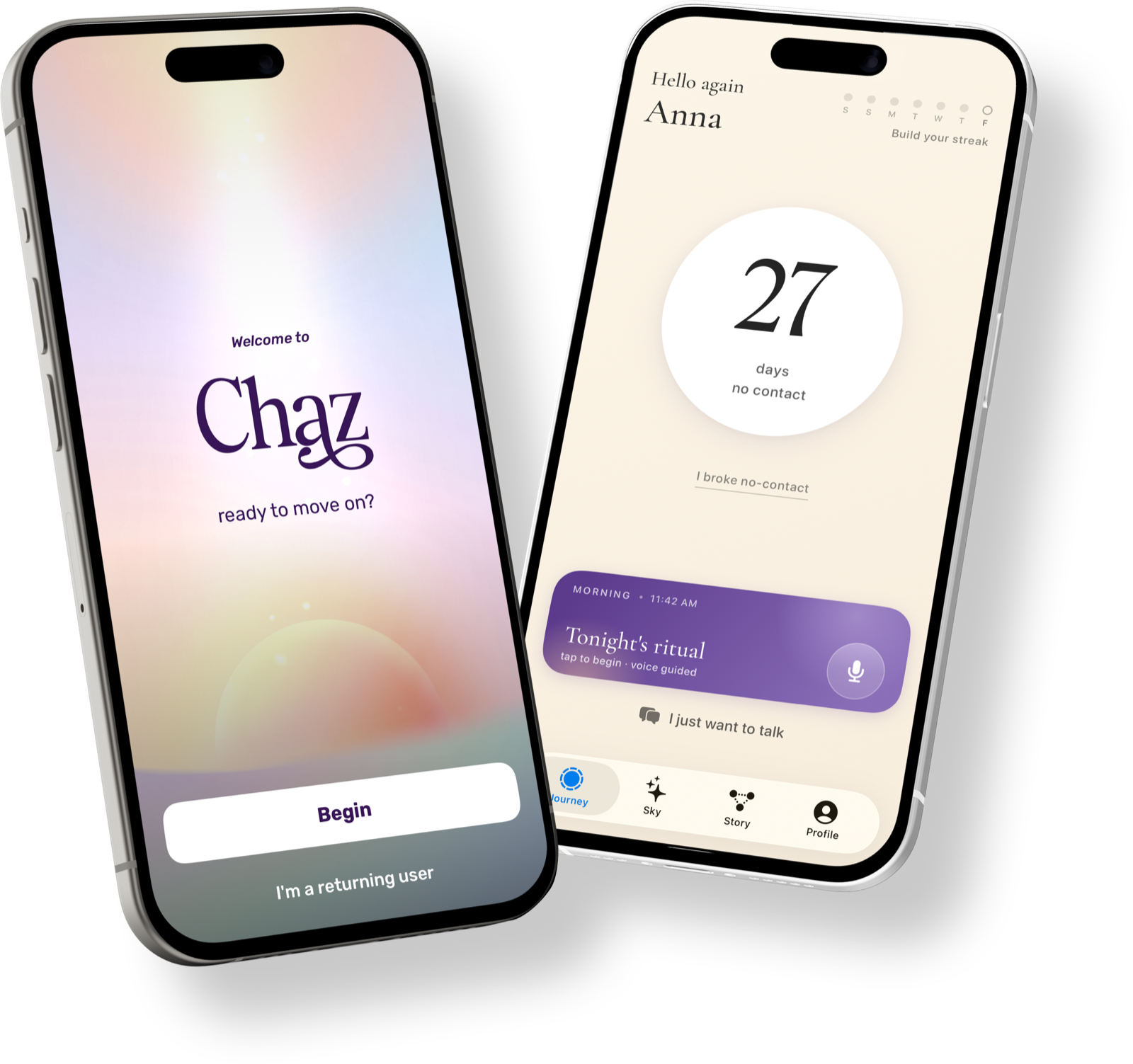
Chaz is built around one job: keep you from texting your ex while you process the breakup. It is voice-first. It tracks your no-contact streak. It journals what you say automatically. It knows what limerence is, what the no-contact rule is, what attachment anxiety looks like at 2 a.m. The tagline is "Don't text him. Talk to Chaz."
What that buys you, compared to a general chatbot, is push. A general chatbot will gently support you talking through the urge. Chaz will challenge the urge in language that sounds like a friend who has had this conversation forty times and has lost patience with the but he said of it all. Whether that voice is what you need depends on you. For a lot of people in the first two months after a breakup, it is the right one.
Use it for: 2 a.m. surges, the urge to break no contact, ongoing tracking of the streak and your emotional state across the recovery.
Do not use it for: depression that has outlasted the breakup, mental health symptoms that need a clinician, any situation where you need a human.
Other domain-specific tools worth knowing
This space is filling out fast. There are 2026-era apps for grief specifically, for sobriety, for postpartum, for caregiver burnout, for sleep, for ADHD-flavored emotional regulation. The pattern is the same: a tighter focus, a more opinionated voice, a deeper understanding of one specific pain. The trade-off is the same: less useful outside the domain.
What an AI companion cannot do, in 2026
This is the section that matters the most.
- It cannot treat clinical depression. If you have been low for more than two weeks, if you have lost interest in things you usually like, if you are sleeping too much or too little, if eating is hard, you need a human. A primary care doctor is a fine first stop. A therapist is the better stop if you have access.
- It cannot handle suicidal ideation. In the US, the 988 Suicide and Crisis Lifeline is available by call or text 24/7. The Crisis Text Line (HOME to 741741) is also available in the US and Canada. The UK has Samaritans at 116 123. Most other countries have equivalents.
- It cannot replace the felt presence of another human. This sounds soft. It is the hardest scientific fact in the room. We are co-regulating animals. Some healing only happens in the presence of another nervous system that is calm.
- It cannot tell you when to stop using it. That is on you.
How to actually pick one
A short decision tree.
- Are you in crisis? Call 988 in the US (or your local equivalent). AI companions are not for crisis.
- Do you have a specific painful situation, like a breakup, where you keep wanting to do the wrong thing? Use a domain-specific tool. Chaz for breakups. Sobriety apps for sobriety. The match is the point.
- Do you want CBT skills? Use Woebot or Wysa. Pair with a workbook if you can.
- Do you want a thinking partner for life in general? Use ChatGPT or Claude. Save the conversations. Reread them in three months.
- Are you lonely in a chronic way? This is the case for cautious Replika or Pi use, and the case for building more human contact, in parallel. The AI is bridging. It should not be the destination.
The honest closing read
AI companions, in 2026, are roughly where running shoes were in 1985. Genuinely useful, sometimes overhyped, occasionally sold to people who would be better served by something else. The good ones do real work. The right ones, used for the right thing, are a meaningful addition to the toolkit.
The one rule that holds across all of them: an AI companion is a relay between your nervous system and the rest of your life, not a destination. You use it on the worst nights so that the days afterwards are slightly easier. You use it to slow down a decision you were about to make at the wrong speed. You use it to put words on something that did not have words yet.
Then you go outside. Then you call a friend. Then you sleep.
That is the whole assignment.