On The Mend · Healing
Is It Breakup Sadness or Clinical Depression?


Most breakup sadness is grief, which is heavy and survivable and resolves on its own with time and the right conditions. Some breakup sadness becomes clinical depression, which is a different thing and needs professional help. The honest line is roughly here: if symptoms have lasted more than a couple of weeks, are getting worse rather than slowly better, and are interfering with your ability to function, please talk to a professional this week. If you're having thoughts of harming yourself, please reach out today. In the US, you can call or text 988 to reach the Suicide and Crisis Lifeline, 24/7, free. This article is not a diagnosis. It's a framework to help you notice when grief has crossed a line.
Why the two get confused
Grief after a breakup and clinical depression overlap enough that even clinicians take time to tell them apart. Both involve sadness, sleep disruption, appetite changes, loss of interest, fatigue, and trouble concentrating. Both can include intrusive thoughts and a flattened sense of the future.
What separates them is not the presence of the symptoms but the duration, severity, pervasiveness, and what triggers them.
Grief is responsive. It is triggered by reminders of the loss and softens between waves. You can still feel joy at other moments, even if briefly. Grief has a target. The target is the lost person and the lost future.
Clinical depression is more pervasive. It dims everything, not just the things connected to the breakup. It doesn't lift in the gaps. It doesn't respond to good news the way the rest of you used to. It can feel less like sadness and more like absence — of energy, of interest, of feeling itself, a state clinicians call anhedonia.
The DSM-5 frames major depressive disorder as five or more symptoms during the same two-week period, representing a change from previous functioning, including either depressed mood or loss of interest. The symptoms include sleep disturbance, appetite or weight change, fatigue, feelings of worthlessness or excessive guilt, diminished concentration, psychomotor agitation or slowing, and recurrent thoughts of death. This isn't to invite self-diagnosis. It's to give you a vocabulary if you talk to a professional.
A side-by-side, with caveats
This table is a rough guide, not a diagnostic tool. The categories blur. Use it to notice patterns, then talk to someone qualified if anything on the right column is true.
| Aspect | Expected breakup grief | Possible clinical depression |
|---|---|---|
| Trigger | Tied to thoughts, reminders, or specific moments | Pervasive, often present without a triggering thought |
| Sadness | Comes in waves with relief between | Constant, no waves of relief |
| Sleep | Disrupted, often improving slowly | Chronically disturbed for weeks, sometimes hypersomnia or severe insomnia |
| Appetite | Reduced for a stretch, returns | Persistently changed, with significant weight loss or gain |
| Energy | Fatigue that varies | Pervasive exhaustion even after rest |
| Interest in life | Diminished but flickers back when you try | Anhedonia — interest doesn't return when you try |
| Self-worth | Bruised, sometimes harsh | Pervasive worthlessness, often unrelated to the breakup |
| Concentration | Hard, especially when distressed | Hard most of the time, including when calm |
| Thoughts of harm | Rare passing thoughts, not action-oriented | Recurrent thoughts of death or self-harm |
| Timeline | Acute phase eases over 8 to 12 weeks for most | Symptoms persist or worsen over multiple weeks with no improvement |
| Response to support | Friends, sleep, exercise help meaningfully | Same supports help little, or briefly, then symptoms return |
If multiple items in the right column describe you, please reach out to a professional. You don't have to be sure. You just have to be willing to get evaluated.
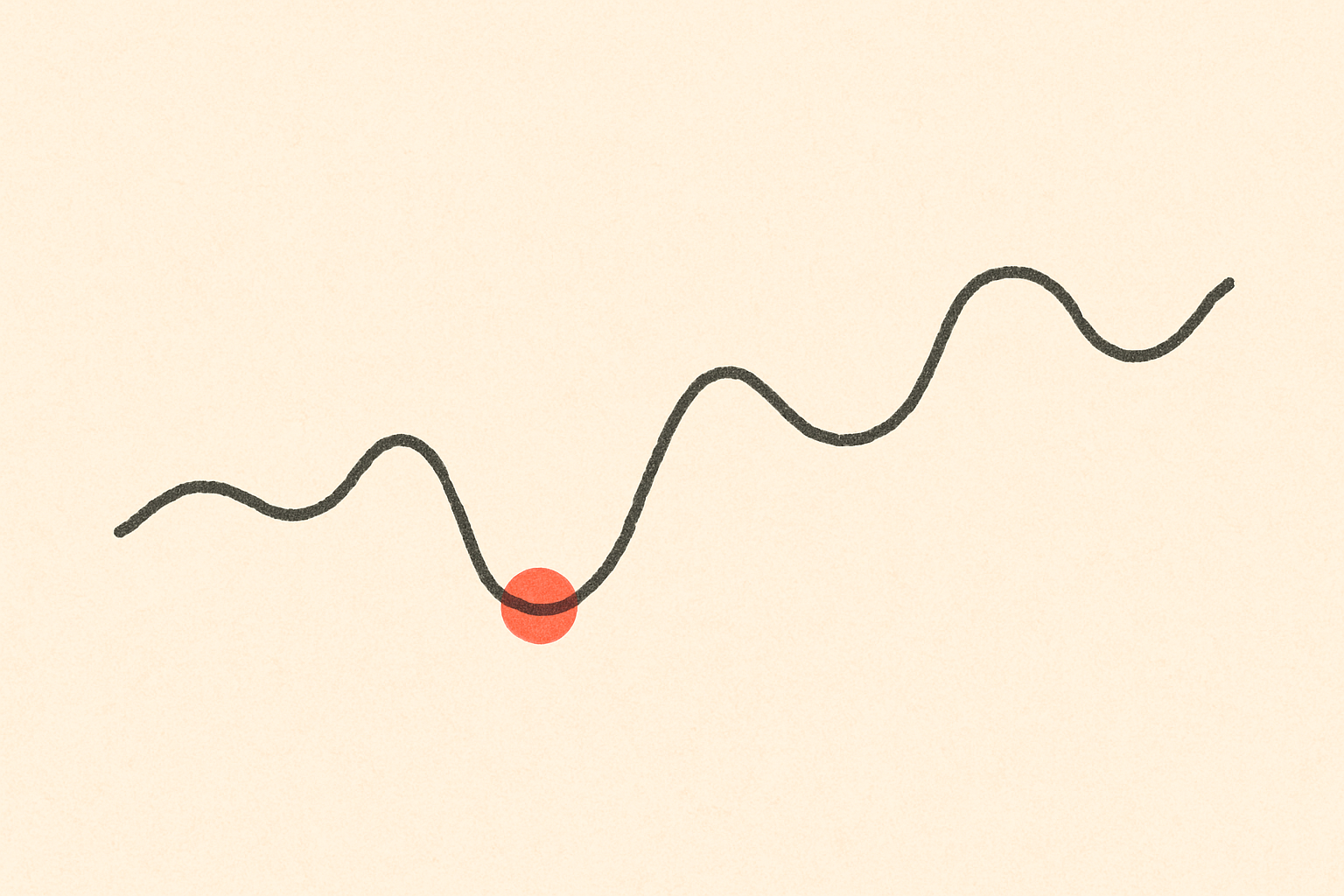
The five signs that should move you from "wait it out" to "talk to someone this week"
These are the ones that matter most.
- The symptoms haven't lifted at all in three to four weeks. Grief should have at least micro-improvements over that span. Total absence of improvement is a yellow flag.
- You've stopped doing basics. Showering, eating, going to work, replying to anyone. Not because you're protesting the breakup, but because you genuinely can't.
- You feel worthless in ways that aren't about the relationship. "I'm a bad partner" is grief talking. "I'm a fundamentally bad person and always have been" is a sign something deeper is in motion.
- You can't feel anything, not just sad. Pure anhedonia, where joy, interest, and even acute grief are all muted, is a marker that the system has flattened.
- You're having thoughts about death, dying, or not being here. Any of these, even briefly, are reason to talk to someone now.
If number five is happening, please reach out today. In the US, 988 is free, 24/7, available by call or text. In the UK, you can call Samaritans at 116 123. In Canada, you can call or text 988. Internationally, the International Association for Suicide Prevention maintains a list of crisis centers worldwide.
You don't have to be in crisis to use these lines. If you're not sure if it's a crisis, that's a fine reason to call. They will help you figure out what kind of support fits.
The "but it's just a breakup" trap
People resist getting help because they feel they shouldn't be "this affected" by something that isn't a death, isn't a diagnosis, isn't a tragedy.
This is wrong. Breakups are well documented as a major psychological stressor, comparable in measured impact to other significant losses. Naomi Eisenberger's research at UCLA has shown that social pain activates many of the same neural regions as physical pain. Heartbreak is not a metaphor. The nervous system treats it as a real injury.
The threshold for getting help is not "this is bad enough to deserve it." The threshold is "I'm not improving and could use support." Therapy after a breakup is one of the most evidence-supported uses of therapy there is, particularly for those with prior depression, anxiety, or attachment-related history. Cognitive behavioral therapy in particular has decades of evidence for treating depressive symptoms.
Getting evaluated does not mean committing to medication or long-term therapy. It means a professional gets eyes on what's happening and helps you figure out what would help. If the answer is "this is grief, you'll be okay, here are some things to try," you've lost nothing. If the answer is something more, you've gained early intervention.
Risk factors that lower the threshold
Some factors make it more likely that breakup sadness will tip into clinical territory. If any of these apply, set a lower bar for reaching out.
- Prior history of depression or anxiety. Stressors often reactivate prior patterns.
- Family history of mood disorders. Genetics matter, even if you've never personally had an episode.
- The breakup involved abuse, betrayal, or trauma. Layered grief is harder than clean grief. See getting over being cheated on.
- Isolation. No close people to talk to, especially during a breakup, raises risk significantly.
- Major identity loss alongside the breakup. Loss of a shared home, kids' routines, finances, immigration status, or community.
- Disorganized or anxious attachment. Especially when attachment was already a source of difficulty before this relationship.
- Current substance use as a coping mechanism. Alcohol use disorder and depressive disorders co-occur more often than chance, and alcohol interacts with mood and sleep in ways that can deepen depressive symptoms.
None of these mean you'll have clinical depression. They mean the risk is higher, and the threshold for getting professional eyes on you should be lower.
A scenario from each side
Grief: You've been sad for three weeks. You cry most days. You're sleeping six hours, badly. You went out with a friend last Friday and laughed twice. The laughter felt strange because you'd been crying earlier. You ate the dinner. The next morning you cried again. The cry was shorter than last week's cry. You went to work. You did not call out sick. You did not text your ex. You felt heavy. You also felt yourself. That's grief.
Possible clinical depression: You've been low for six weeks. The first two weeks looked like grief. Then it kept getting worse. You stopped going to the gym, stopped answering most texts, stopped cooking. You haven't gone outside in three days. You can't remember the last time something felt good. You're not just sad about the breakup. You're flat about everything, including things that have nothing to do with them. You're sleeping ten hours and you're still exhausted. You've started having quiet thoughts about not being here. That is the line. Please call your doctor, a therapist, or 988 this week. You do not have to know what's happening. You just have to talk to someone who can help you sort it out.
What to do if you're not sure
A short, honest list:
- Talk to a primary care doctor. They can do a basic screen and refer you out.
- Use a therapy directory like Psychology Today, Inclusive Therapists, or BetterHelp. The first session is often within a week.
- Tell one trusted person in your life what you're experiencing, including the parts you're worried about.
- Track your symptoms in a notebook for a week. What you're feeling, when, how long, what triggered it, what helped. Bring it to whoever you talk to.
- If your insurance has an EAP (employee assistance program), they often cover several therapy sessions at no cost.
This is not a moment for stoic self-management. It is a moment for asking for help. The best clinicians are not surprised by anything you'll say. They've heard it.
Where Chaz fits, and where it doesn't
A clear note about what Chaz is and isn't.
Chaz is an iPhone app for tracking your no-contact streak and giving you a voice agent to talk to instead of texting your ex. It can help with grief loops, urges to break contact, late-night intrusive thoughts, and the general bandwidth crunch of a breakup. It is free, it is iPhone only, and it is real support for the daily-life part of getting through this.
It is not a therapist. It is not a crisis line. It is not equipped to handle severe depressive symptoms or suicidal ideation. If you're at that line, please use a crisis service like 988 (US), Samaritans (UK), or your local equivalent, and reach out to a therapist or doctor as soon as you can. Chaz can sit alongside professional help. It is not a substitute for it.
The closing thought
Most people reading this are dealing with grief, not clinical depression, and most people will be okay without a higher level of intervention. The reason to know the line is so that if you're past it, you don't waste weeks calling it normal.
Asking for help is not a referendum on your strength. It's a referendum on whether you're alone with this or not. You don't have to be alone with this. There are people whose job is to help, and reaching one of them is a phone call away.
If your gut is reading this article and saying "this might be me," trust the gut. Make the call. The worst outcome is that a kind professional tells you you're okay. That outcome is not bad.
Take care of yourself. You're worth a phone call.