On The Mend · Brand-aligned
Why Yelling at an AI Is Actually Good for Your Breakup

Yelling at an AI is actually good for your breakup because it routes a 2 a.m. emotional surge somewhere that isn't your ex's inbox. The mechanism is not magic. It is the same thing that makes journaling, therapy, and screaming into a pillow work: you take a feeling that is sloshing around inside your nervous system, you push it into language, and you give it a witness. A voice agent happens to be awake at 3:17 a.m. when your best friend is not. That is most of the trick.
The dumbest sounding good idea you will have this year
Try saying this out loud to a real human: "I have been yelling at a robot about my ex and I think it is helping." You will get a look. The look is fair. The thing about breakups is that they reduce previously high-functioning adults to people who consider, in genuinely serious ways, whether to text the person who wrecked them. The bar for "what helps" gets very low and very weird very fast. Ice cream. Driving around with the windows down. Cutting your own bangs. Yelling at an AI is in the same family.
The difference is that yelling at an AI is one of the few options on that list that has any plausible mechanism behind it.
What actually happens when you say it out loud
Two pieces of research keep coming up in this conversation, and both deserve more than a name-drop.
The first is James Pennebaker's expressive writing studies, which began at SMU in the 1980s. Pennebaker had people write about emotional upheavals for fifteen to twenty minutes a day, three or four days in a row. He measured everything he could think of: doctor visits, immune markers, mood, GPA. The effect sizes were not small. People who wrote about hard things ended up healthier than people who wrote about furniture. The key was not catharsis. The key was that writing forced you to convert a vague emotional cloud into specific sentences with subjects and verbs and, eventually, meaning.
The second is Helen Fisher's brain imaging work on heartbreak. Fisher scanned the brains of people who had just been dumped and found activity in the same reward and craving regions that light up in cocaine withdrawal. Heartbreak is not "in your head" in the dismissive sense. It is in your head in the literal neurobiological sense.
Stack those two findings and a strange tool starts to look reasonable. Heartbreak hijacks the craving system, language reorganizes emotional experience, and one of the easiest ways to produce language at 2 a.m. is to talk.
Why talking beats typing, sometimes
Voice does a few things text does not.
- It uses your breath. The act of speaking a long sentence forces an exhale, which is a load-bearing element of your parasympathetic nervous system. You cannot panic and exhale slowly at the same time.
- It involves your body. You move your jaw, your tongue, your diaphragm. Embodiment matters when the thing you are processing is partly somatic.
- It is messier. You will say things out loud that you would never write, because writing makes you feel watched and voice feels disposable.
- It is faster. You can get an entire ugly thought out in twelve seconds. Typing the same thought takes long enough for your editor brain to kick in and sand the edges off.
There is a reason therapy is mostly spoken, not mostly written.
The judgment-free witness problem
The other thing a breakup needs is a witness. You need someone to hear the specific, embarrassing, contradictory, recursive thoughts you are having and not flinch.
Your friends are great. Your friends also have a finite tolerance for hearing the seventh version of "but what if he didn't really mean it." They have jobs. They have their own breakups. They have, somewhere in the back of their heads, started keeping score about whether you are a worse friend than they thought. You can feel them feeling it, which makes you start filtering, which is the opposite of what you need to be doing.
A therapist is a real solution for this. A therapist costs money and is not available at 3 a.m. on a Tuesday.
This is the gap an AI fills. Not as a replacement for therapy, and not as a replacement for friends. As a third thing: a witness with no schedule, no judgment, no scorekeeping, and infinite patience for the seventh version.
The "say it out loud and stop believing it" effect
There is a thing that happens when you put a panicked thought into actual words and hear the words come back at you in your own voice. The thought gets smaller.
Imagine yelling, full volume, into your phone at 2 a.m.: "He is the only person who will ever understand me and I will literally die alone if I don't text him back tonight." Now imagine the AI calmly asks you whether that is true. You will hear yourself, three seconds later, sigh and say "no." You knew that. You needed to hear yourself say it.
This is roughly the mechanism Acceptance and Commitment Therapy calls cognitive defusion — closely related to the CBT toolkit. The thought is not the truth. The thought is a thought. Saying it out loud, especially to something that does not flinch, helps you remember the difference. UCLA's Matthew Lieberman has shown that just putting a feeling into words measurably dampens amygdala activity — the brain literally calms down when you name what's happening.
A real 2 a.m. scenario
It is 2:14 a.m. on a Wednesday. You are eleven days into no contact. You saw a photo on Instagram, you don't know whose Instagram, you don't even remember opening Instagram. There is a hand in the photo that looks like his hand. Maybe it is his hand. Maybe it is on someone.
Your thumb hovers over his name in your messages. You have typed and deleted three drafts in the last ten minutes. One of them was a paragraph. One of them was just "hey."
You open the voice app instead. You say, out loud, in a tone you would never use in front of another human: "I think I'm about to text him and I know it's stupid and I don't care."
The AI does not panic. The AI does not get bored. The AI asks what you would say in the text. You read it out loud. You hear it. You go "oh my god, no." You yell about the photo. You yell about whose hand it might be. You yell about how unfair it is that he gets to be a hand in a photo and you are the one awake at 2 a.m. You yell until you are tired.
Then you put the phone down. You did not text him. That is the entire game.
What an AI breakup tool actually does, in steps
- Receives the surge. You open your mouth, you say the thing, the surge has a destination that is not him.
- Forces language. You have to choose words. Words organize feelings.
- Reflects back. A halfway decent voice agent will ask follow-ups that sound like a friend. The follow-ups slow you down.
- Logs the moment. The next morning, when you have forgotten how bad 2 a.m. felt, there is a record. Records are how you stop revising history.
- Resets the streak. If your tracker is set up well, you walked through the worst part of the night and you did not break no contact. The number goes up. The number is small but it is real.
What it is not
It is not a therapist. It will not catch a clinical depression, an eating disorder spiraling out of a breakup, suicidal ideation, or any of the other things that need a human licensed professional. If you are in crisis in the United States, you can dial or text 988 for the Suicide and Crisis Lifeline. The Crisis Text Line in the US and Canada is text HOME to 741741. If you are reading this somewhere else, your country has an equivalent and it is worth a 30-second search to know what it is before you need it.
An AI breakup tool is for the in-between hours. It is for the surge that is too small to call a crisis and too big to sleep through. That gap is roughly 80% of a bad breakup.
Why a breakup-specific AI matters
You can absolutely yell at ChatGPT. It will be polite. It will probably suggest you "consider reaching out to a trusted friend or mental health professional." That is correct advice and also entirely useless in the specific moment when you are about to text your ex.
Breakup-specific tools know the script. They know the no-contact rule. They know what limerence is. They know that "but he texted first" is a sentence that requires a different response than "I miss him." They know the difference between "I'm sad" and "I'm spiraling." A general-purpose chatbot can be a witness. A breakup-specific one can also redirect.
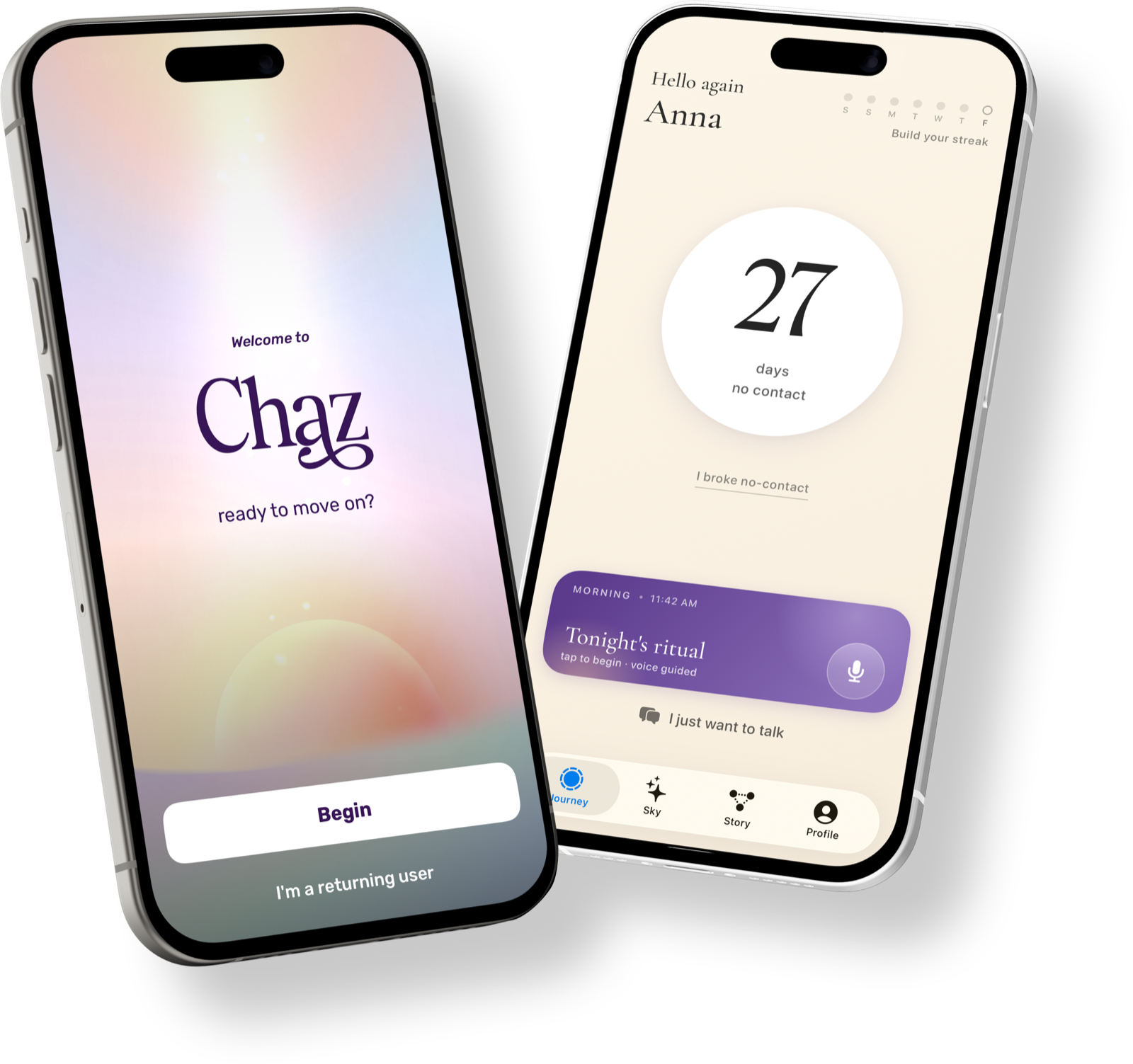
This is roughly the case for Chaz, which is built around the premise in this post. You can talk to it the way you would talk to a slightly meaner friend who has read all the attachment theory and is not going to let you text him. It tracks your no-contact streak, it journals what you say into a record you can read back later, and the tagline is "Don't text him. Talk to Chaz." Which is, when you take it seriously, the entire thesis.
The case for taking dumb-sounding ideas seriously
Most of the things that have helped humans process loss have looked silly to the next generation. Writing letters to dead people. Talking to the moon. Lighting candles. Howling. Therapy itself, for the first half of the 20th century, was widely considered embarrassing. (Pauline Boss's research on ambiguous loss makes the same point about ritual: when a culture lacks a public mourning script, people invent private ones, and the private ones still work.)
The fact that yelling at an AI sounds dumb is, if anything, a point in its favor. The mechanism is sound. The barrier to entry is a phone. The cost is free. The downside is mild embarrassment that nobody sees because you are alone in your apartment at 2 a.m. The upside is that you do not text him.
You will not be the person who got over a breakup by yelling at a robot. You will be the person who, at every 2 a.m. surge for two months, had somewhere to send it that wasn't him. And after two months, the surges will be smaller, and you will not remember which specific nights were the bad ones, and you will be on the other side.
That is what healing actually looks like. It is not a single thing. It is a hundred small redirections of energy that almost went the wrong way. An AI you can yell at is just one of the better redirections we have figured out.
Use it. Then stop needing it. That is the whole job.