On The Mend · Healing
How to Stop Loving Someone Who Doesn't Love You Back

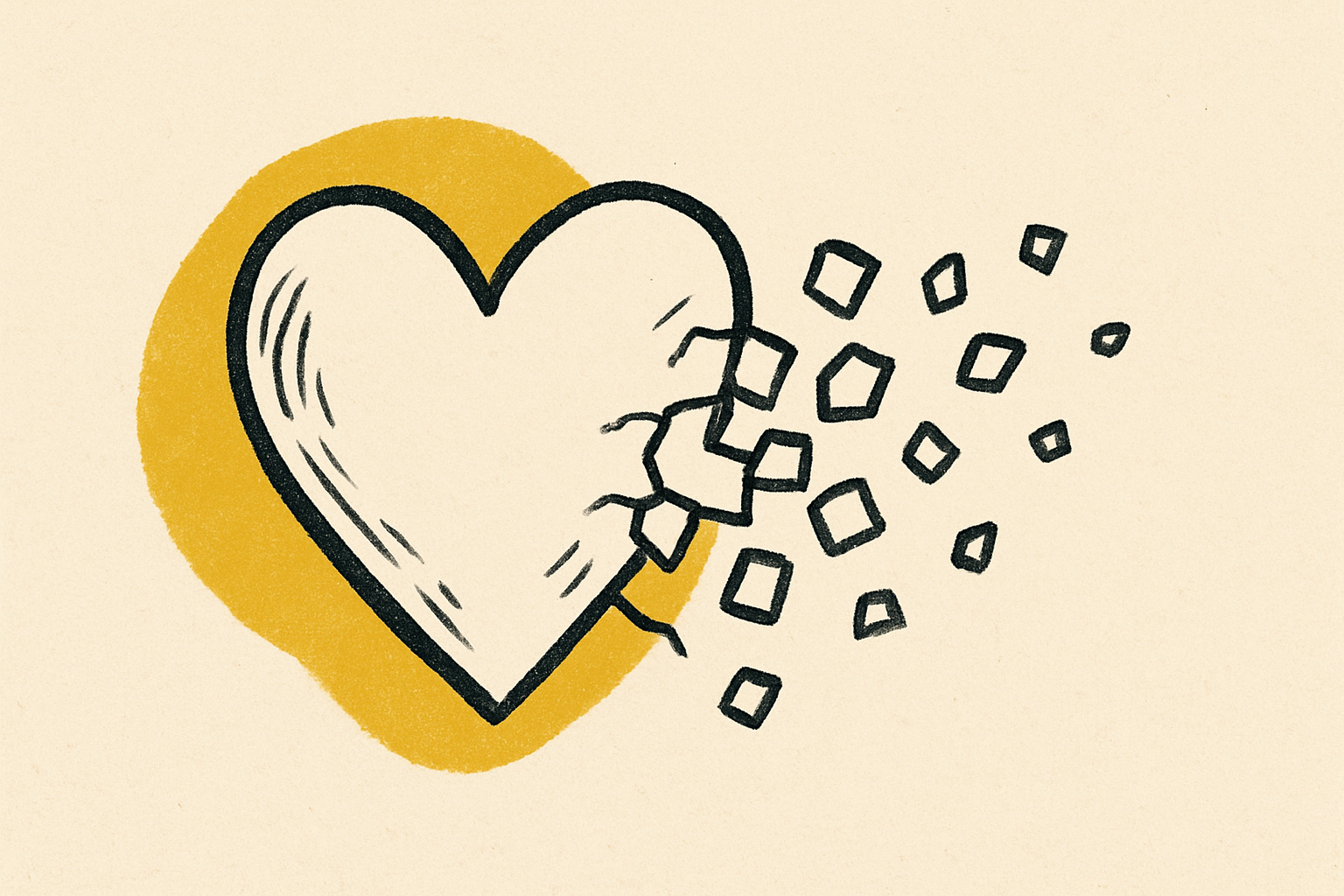
You cannot decide to stop loving someone. Love is not a switch, it's a habit, a chemistry, and a long set of neural pathways carved by repeated contact. What you can do is stop feeding the habit, let the chemistry fall, and give your brain new pathways to run on. The love fades when the inputs change. This is the actual process, with no platitudes, for how to stop loving someone who doesn't love you back.
Why willpower doesn't work here
People come into this question wanting a thought trick. There isn't one. Helen Fisher's brain-imaging research on romantic rejection found that people freshly dumped show activity in the ventral tegmental area, nucleus accumbens, and orbitofrontal cortex — the same circuitry involved in addiction and motivation. Loving someone, especially someone you can't have, is biochemically close to craving a drug. You can't talk yourself out of a craving. You can only stop dosing.
Saying "I'm going to stop loving them" while still texting them, checking their profile, replaying old voicenotes, and lingering in the same room with their toothbrush is like saying "I'm going to quit smoking" while keeping a pack open on the counter. The decision is real. The conditions undermine it.
So the work isn't to stop feeling. The work is to stop providing the brain with reasons to keep feeling.
The love-as-habit framing
Romantic love has three overlapping systems, according to Fisher and others: lust, attraction, and attachment. Attachment is the long one. It's built by repetition — the same person, the same routines, the same texts every morning — and it doesn't unbuild itself just because the relationship ended.
That's why so many people describe still loving someone they no longer like, or no longer respect, or no longer want to be with. The attachment system doesn't ask your opinion. It runs on conditioning.
Conditioning unwinds in one of two ways: extinction (the cue happens and the reward doesn't follow, over and over, until the cue stops triggering the craving)) or replacement (a new pattern overwrites the old one). Both are slow. Both require you to stop reinforcing the original loop.
The 6 things that actually unwind it
This is the unromantic, evidence-aligned version of "how to stop loving someone."
1. Stop providing inputs
Every input is a small reinforcement. Every text, every story view, every "let me just see if they posted," every time you say their name out loud in a story you've told twelve times. The attachment system is reading every input as "this person is still relevant to my survival."
Full no contact is non-negotiable here. Not just no texting them. No checking. No asking mutuals. No looking at the archive of their posts. The first two weeks are the worst. Read what is the no-contact rule for the full structure.
2. Make their presence in your environment small
This is environmental design. You're trying to make their existence less salient in the spaces where you live.
- Photos off the phone home screen. Move them to a hidden album, not delete, unless you want them deleted.
- Their texts archived or moved to a folder you don't see by default.
- Their contact renamed to something deliberately unromantic — initials, "do not text," anything that breaks the muscle memory of their name appearing.
- Their belongings in one box, in a closet, out of sight.
- The playlist they made you, off your main library.
- The chair, the side of the bed, the coffee mug, the route past their apartment — re-engineered when possible.
None of this is symbolic. It's all interference with the cues that keep the attachment running.
3. Process the love instead of pushing it away
This is counterintuitive but important. Trying to suppress the feeling makes it louder. Ironic process theory, from Daniel Wegner's research, shows that actively trying not to think about something increases the frequency of the thought.
What works instead is structured acknowledgment. A daily journaling slot. Twenty minutes, same time, same notebook or app. You write what you feel about them. You don't argue with the feeling. You name it, you let it be there in writing, you close the notebook.
This is also where you can write the unsent letter — the long, honest, never-going-to-be-sent letter that says everything you would say if you could. The act of writing it externalizes the loop. The act of not sending it is the discipline that lets the loop end.
4. Build new pathways
The brain needs somewhere new to put its attention. Not as a distraction, but as actual rewiring.
- A new physical practice. Running, lifting, climbing, swimming, dance. Something with consistent reps so it becomes a default.
- A new social context. New gym, new coworking spot, new monthly meetup, new hobby. People who didn't know the relationship.
- A new skill that's hard enough to require your attention. Language, instrument, craft, code.
- A new route. The way to work, the coffee shop, the grocery store. Small changes break old cue patterns.
The point isn't to "be busy." The point is to give the brain genuinely new inputs so the old loops have less to attach to.
5. Re-tell the story honestly
Most of the lingering love comes from a sanitized version of the relationship you keep replaying. The version where they were mostly great and you mostly ruined it, or where it was mostly magic and ended for mysterious reasons.
Write down the actual story. Both columns. The things that worked, and the things that consistently didn't. The way you felt on a Tuesday at 6pm, not just the highlight reel.
This is not about hating them. It's about letting the picture be the right shape. You can't stop loving a person who, in your head, was perfect. You can stop loving the actual person, who was loved by you and was also a real, finite, flawed human who, in this particular case, did not love you back.
This step is uncomfortable because it threatens the version of you who loved them. That version is also grieving. Let her grieve. The story still needs to be honest.
6. Wait
This is the part nobody wants. After all the work above, you still have to wait.
The attachment system doesn't decline on a fixed schedule. For most people, the acute "I still love them" fades meaningfully over weeks to months. The full quietness — where you can hear their name without something in your chest doing anything — takes longer. Six months. A year. Sometimes more.
You're not failing if the love doesn't disappear on your timeline. You're not weak for still feeling something. You're a person whose nervous system was wired to a specific other person and is now slowly being unwired. That takes the time it takes.
A scenario, week 4
You wake up and don't think about them for the first 45 minutes. You notice this and immediately think about them, which kind of ruins it, but you also notice you didn't lead with the thought, which is new. You get coffee at a different place than the one you used to go to with them. You don't text them. You go to a workout class where nobody knows you knew them. At 10pm a song comes on that wrecks you and you cry on the floor for ten minutes and then you get up and brush your teeth and go to bed. None of that day was triumphant. All of it was the unwinding.
When loving them turns into something else
Sometimes what people call "love" after a long no-contact stretch is actually one of the following, and naming it correctly helps you let it go:
- Habit attachment. Your nervous system is used to them. That's not love. That's familiarity.
- Unfinished story. You want a resolution they didn't give you. That's grief, not love.
- Limerence. Obsessive thought patterns and idealization, a state first named by psychologist Dorothy Tennov. See limerence explained. Limerence isn't love either, even though it feels intense.
- Identity hangover. You loved who you were with them. Losing them feels like losing that self. The fix is rebuilding self, not retrieving them.
- Self-punishment. Some people keep loving an unavailable person because, on some level, it feels safer than risking love with someone available. This one is worth therapy.
You can love someone, fully and genuinely, and still arrive at the conclusion that the love is not enough reason to keep your life organized around them. Loving them and being done with them are not contradictory.
Where Chaz fits
The single move that most often re-triggers the love loop is contact. One text reopens the system. The streak is the protection.
Chaz is an iPhone app that tracks your no-contact streak and gives you a voice agent you can yell at instead of texting the person you're trying to stop loving. You can rage, sob, list every reason you still love them, do the unsent-letter thing out loud, and the app talks back without you ever pressing send to the person who isn't loving you back. It's free, iPhone only.
It is not a substitute for the work above. It is the late-night pressure valve that keeps you from undoing the work in one sentence.
The closing thought
You're trying to stop loving someone who didn't love you back. That sentence is doing a lot of work, and most of it is grief. The love isn't the problem. The being-loved-back not being available is the problem.
You will not stop loving them by tomorrow. You will, with time and conditions changed, stop being run by the loving them. There's a difference. The love can soften and become a quiet thing you used to have. It doesn't have to disappear for you to be okay.
You just have to stop feeding it. Then live a life. Then look up in a year and notice you've stopped checking.
That's it. That's the whole thing. Begin where you are.