On The Mend · No-Contact Rule
The 90-Day No-Contact Rule: For When You Mean It

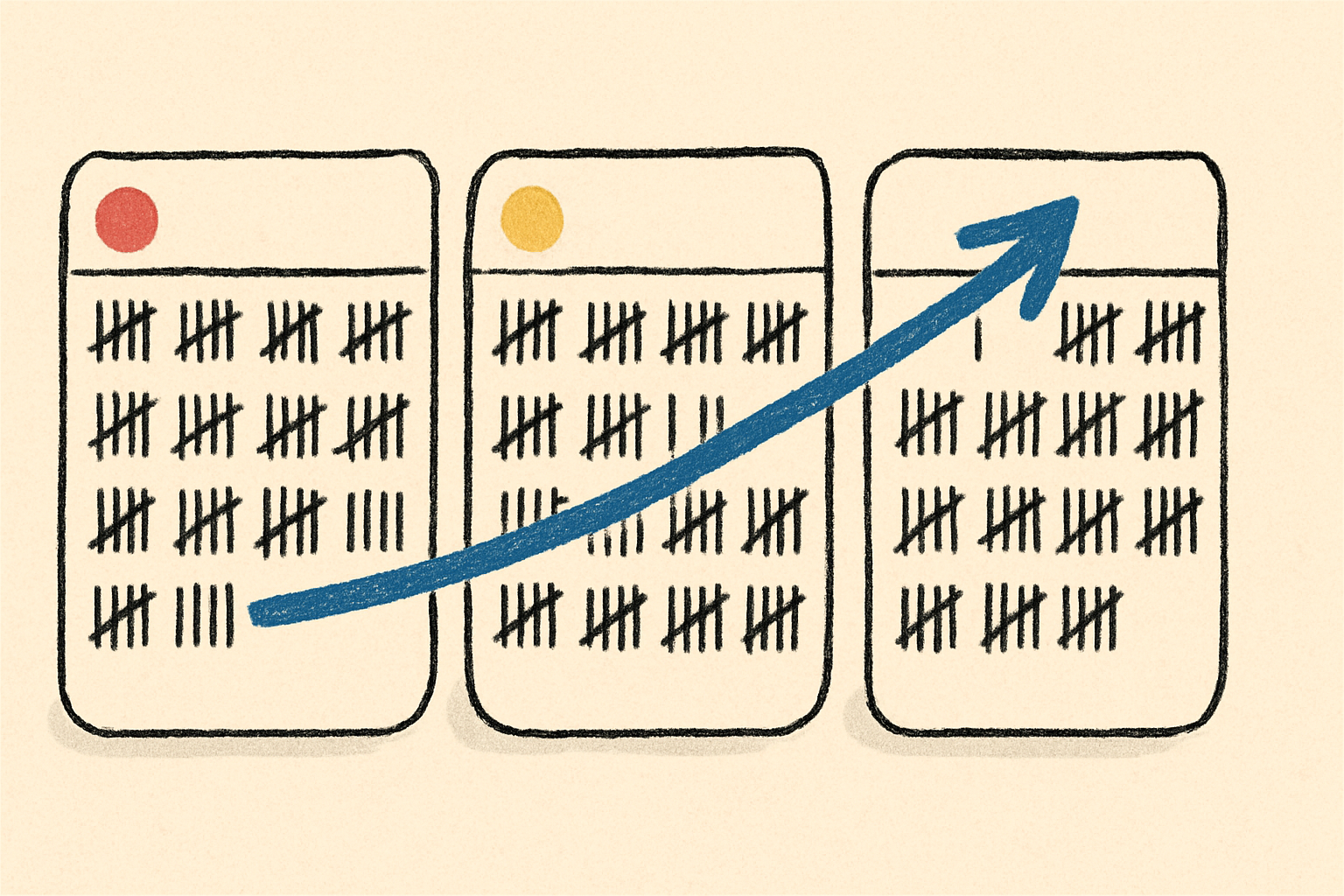
The 90-day no-contact rule is three full months of zero direct contact with your ex, used after long relationships, marriages, cohabitations, situationships that ran for years, or any breakup involving betrayal. Ninety days is long enough for the neurochemistry to actually reset, the identity reorganization to finish a first pass, and at least one season change so the calendar itself stops being haunted. It is the gold standard not because the number is magic, but because three months is roughly how long deep attachment loss takes to stop being the main fact of your life.
Why 90, specifically
Helen Fisher's neuroimaging research on romantic rejection consistently shows that the brain regions involved in romantic love and craving stay active for weeks after a breakup, and that the deactivation curve is gradual. For short or mild attachments, 30 days is enough to move past the peak. For deep attachments — the ones you built a life around — the curve takes longer.
Three things change at the 90-day mark that don't fully change at 60:
- Neurochemical reset. The dopaminergic loop that was firing every time you got input has had enough silent time to genuinely weaken, not just dampen.
- Identity reconstruction. You've had enough time to repaint not just your bedroom but your routines, your friend group's center of gravity, and the way you describe yourself in your own internal monologue.
- A season change. Whatever season you broke up in, you've now lived a full quarter without them. The weather is different. Your wardrobe is different. The calendar has stopped being a series of "remember when we did this" anniversaries.
That third one is underrated. Grief tracks the calendar. Surviving one season without them quietly rewrites it.
Who should pick 90
Be honest with yourself on this. The wrong-sized rule fails. Ninety is right when any of these are true:
- The relationship was three years or longer.
- You lived together.
- You were married, engaged, or were planning to be.
- The breakup involved cheating, lying, financial betrayal, or any other rupture of trust.
- It was a first love or any relationship that started before you were 22.
- You've failed shorter attempts and the brain hasn't released the loop.
- You describe yourself as "obsessed" with thoughts of them without irony.
- It was a situationship that never got formalized but ran for two or three years and felt heavier than any of your actual relationships.
If none of these apply, you might be over-engineering. See how long should no contact last.

What the 90-day arc actually looks like
Not a clinical timeline. A composite from breakup-recovery work and the attachment-loss arc John Bowlby described as protest, despair, and reorganization.
Month 1: protest and acute withdrawal (days 1-30)
This is the loudest month. Crying, drafted texts, intrusive thoughts, no appetite or too much appetite, real chest pain — in extreme cases the stress surge can even produce takotsubo cardiomyopathy — and dreams about them. Helen Fisher's work compares this to substance withdrawal because the same circuitry is doing the same job.
The rule for month 1: do not contact them. That is the whole rule. You do not need to feel fine. You need to not text. Lower the bar. Survive.
If you're newly here, the 30-day no-contact challenge post has the full setup. Do all seven setup steps in the first 24 hours.
Month 2: despair and reorganization beginning (days 31-60)
The acute pain has eased. The bad surprise of month 2 is that it doesn't feel like joy. It feels like depression-shaped flatness. You're functioning. You're not crying daily. You're also not enjoying anything yet. Some of this is hormonal — chronically elevated cortisol from prolonged stress blunts mood and motivation in exactly this pattern.
This is the part nobody warns you about. It looks like backsliding. It is not. It is the protest phase exhausting itself before the reorganization phase has anything to offer.
The work in month 2:
- Pick up one real activity that meets regularly. A class, a league, a volunteer commitment.
- Make one physical change to your space.
- Schedule three social commitments in the next four weeks so the calendar pulls you forward.
- Resist the "we could be friends now" lie. You cannot. Not yet.
See 60-day no-contact rule for the full month-2 deep dive.
Month 3: reorganization (days 61-90)
This is the month where you become someone different, quietly. You will not notice from the inside until later. From the outside, friends will start saying things like "you seem like yourself again" or "you laughed at that the way you used to."
What happens in month 3:
- Songs that used to wreck you become just songs.
- You realize, in passing, that you don't actually want to text them anymore. Not because the urge is being suppressed. Because the urge is gone.
- You can think about the relationship with some distance. You can see the good parts clearly, and you can see the parts that were rotten, and both are true.
- A new opinion shows up that is fully yours, that you didn't even know you had. This one is the moment.
By day 90 you are not "over it" in some triumphant Instagram sense. You are reorganized. The relationship has a shape inside your life instead of being the shape of your life.
The mid-point slumps
Two predictable slumps inside the 90-day arc. Knowing them helps you not break the rule when they hit.
The day-30 false ceiling
Around day 30 you'll feel a real lift. First time in a month you have a genuinely okay day. Your brain will whisper, "we could text now, we're fine." You are not fine. You are improved. The lift is the first descent of the curve, not the end of it. Stay the course.
The day-50 to day-60 dip
Somewhere around days 50-60 a lot of people hit a second valley. The crisis is over, the lift has stabilized, and now you're sitting with the fact that this is just your life now and it's quieter than you wanted. This is reorganization fatigue. The work feels boring and there's no clear progress. Most relapses at the 90-day length happen here.
Get through it by adding social structure and physical activity, not by introspection. Action moves you through this part better than thinking.
A real-life example
Devon was married for six years. His wife left him for a coworker. He found out via a friend before she told him. The first three weeks after he moved out were a blur of crying in the car. He set 90 days. He picked the date on the calendar and put it in his phone.
Days 1-30 were withdrawal. He texted her once on day 14, got a cold reply, restarted the count, deleted the thread. Days 30-60 were the flat phase. He repainted the apartment, joined a climbing gym, started seeing a therapist twice a week. Days 60-90 he stopped reading her name on shared accounts as a wound. Day 90 he canceled the shared Spotify and felt nothing where there had previously been a knot.
Day 91 he didn't text her. Day 120 a mutual friend told him she was engaged to the coworker. He felt a flash of pain and it was gone in an hour. The 90 days had not made her come back. It had made him someone who didn't need her to.
How to actually run a 90
Run the same setup as the 30-day challenge, with three additions for the longer haul.
- A weekly check-in with yourself. Sundays, 15 minutes, a short journal entry. What's better, what's still hard, what surprised you. By week 12 you'll have a written record of the change.
- Therapy or a support group. If the breakup involved betrayal, cohabitation, or marriage, this is not optional. A therapist or a structured group makes the 90 sustainable. The rule alone is not the whole intervention.
- A finish-line plan that is not a finish line. Pick something to do on day 91 that is not about your ex. Not a celebratory text. A trip, a meal with friends, a class, a quiet day, a small purchase you've been deferring. The day after no contact should be a continuation of the new life, not a graduation party for it.
Where Chaz fits over 90 days
A 90-day streak is mostly won at night. The morning version of you is rational. The 11pm version of you, especially in month 2's flat phase, is the one who actually breaks no contact.
Chaz is the iPhone app built for that exact gap. It tracks the streak so the silence has a visible cost. It gives you an AI voice agent you can yell at, so the urge has a target that isn't his number. The journal stores what you said in the moment, so when you're in the day-55 slump you can read day-7 and see how far you've come. Free, iPhone only. Don't text him, talk to Chaz.
On day 91
You wake up. You don't text them. You think about it less than four seconds and the thought passes.
You might extend, indefinitely or to some new arbitrary length. You might just stop counting. Both are fine. The 90 days did the work.
If your ex shows up on day 91 asking to talk, you'll have a choice you couldn't have made on day 4: a real one, made from your own ground, not from the chemistry. People who reconcile after a real 90-day silence and actually rebuild something are mostly the people who got to the point of not needing to. That is not a coincidence.
You did this. Whatever happens next, the version of you who came out the other side of three months of silence is the one writing the rest of the story.