On The Mend · Edge Cases
How to Get Over Being Cheated On

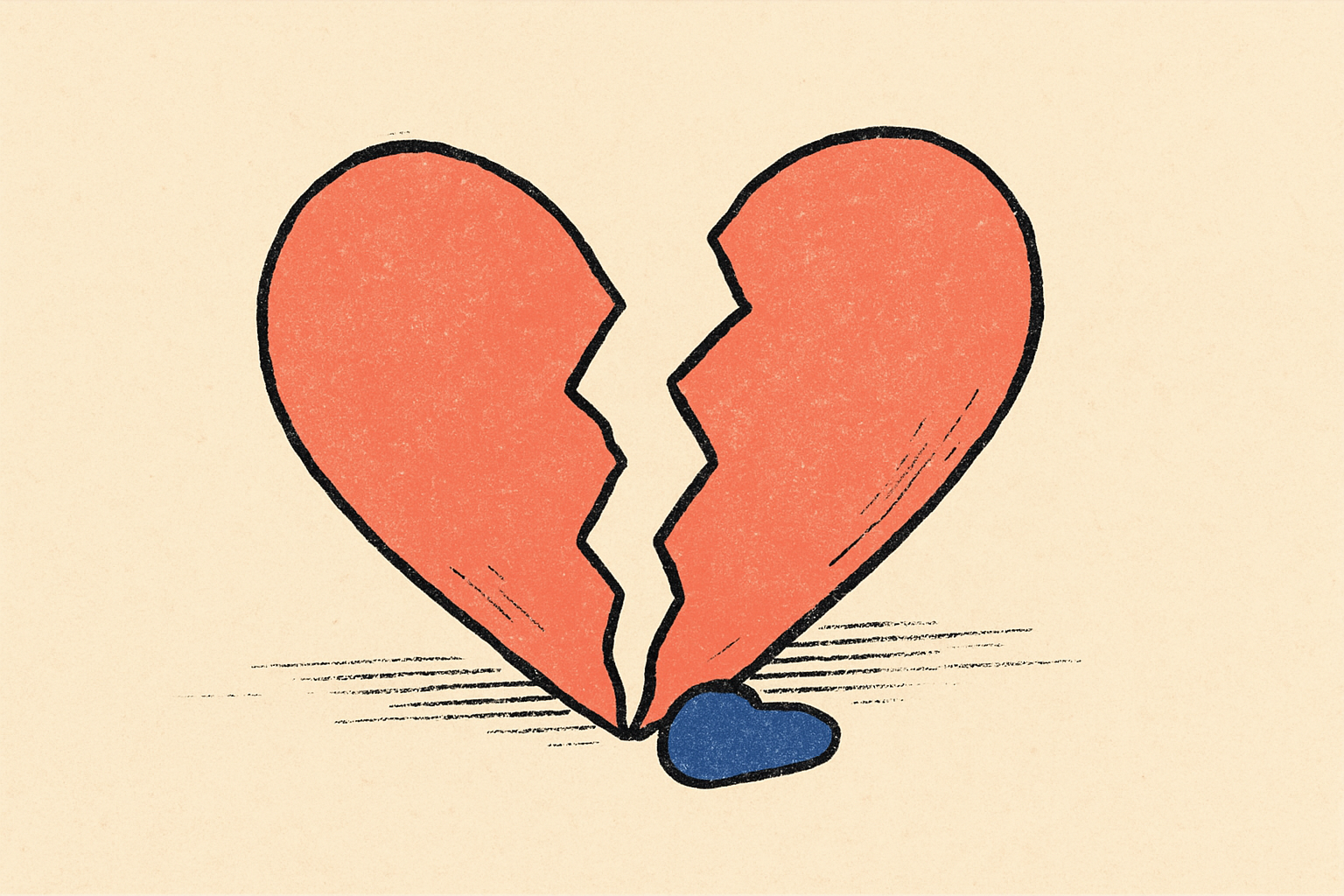
Getting over being cheated on is not the same project as getting over a breakup. A breakup is grief. Infidelity is grief plus a trust injury that lives in the body and rewrites how you read other people for a long time after. This post is about what happens after you've made the decision to leave — not whether to leave, not whether to forgive, just what the road looks like once you're walking it. The first thing to know is that it takes longer than you've been told, and that the timeline is not a measure of your strength.
Why this hits differently
When a relationship ends in honest collapse — you grew apart, you wanted different things — the brain has a story it can use. There's no villain. There's a sad ending, and you can file it.
When a relationship ends because the other person was running a secret, the brain doesn't get to file anything. It has to re-examine every memory in light of new information. The trip you took last spring. The night they were "working late." The way they laughed at something on their phone. Every memory gets reopened and edited. That process is exhausting and it can take months, not weeks.
A few specific phenomena come with this terrain:
- Intrusive imagery. Mental movies of the affair, often graphic, that show up unbidden. This is a trauma response, not a sign you're obsessed.
- Hypervigilance. You start scanning new partners, friends, even coworkers for the patterns you missed before. This is the nervous system trying to make sure it never gets caught again.
- Sleep disruption. Especially in the first month. Cortisol stays elevated. You wake at 4am with your jaw clenched.
- Identity quake. You don't just doubt them. You doubt your own perception. "How did I not see it" becomes "What else am I not seeing."
- Anger that arrives late. Many people feel numb for the first weeks and then enraged a month in. The anger is healthy. It's the body recognizing what was done to it.
Esther Perel, who has written more carefully about infidelity than almost anyone, describes the betrayal as breaking not just the relationship but the personal narrative — the story you'd been telling yourself about your own life. That's why being cheated on can feel like a death even when nobody died. You're mourning the version of the relationship you thought you were in.
The stages, honestly
There's a clean version of breakup grief that goes through five stages and ends with acceptance. Infidelity recovery has those stages but they're noisier, and they don't go in order. A more honest map looks like this:
| Phase | Roughly when | What's actually happening |
|---|---|---|
| Shock | Days 1-14 | Body in alarm. Eating and sleep destabilized. You may feel weirdly calm. That's not okay, that's dissociation. |
| The reconstruction | Weeks 2-8 | You replay everything. You want every detail. You want none of the details. Both. |
| Rage | Weeks 4-12 | Anger arrives, often surprising you. This is healthy. Direct it, don't suppress it. |
| Grief proper | Months 2-9 | Sadness about the relationship you thought you had. Less about them, more about the loss. |
| Re-trust | Months 6-24 | Slowly trusting your own perception again. Then, eventually, other people. |
| Integration | Year 1-3 | The story becomes one you can tell without shaking. They lose centrality. |
You will move between these phases non-linearly. Rage will come back in month seven. Grief will resurface on the anniversary. None of that means you're regressing. It means the wound is doing what wounds do.
What to do in the first month
The first month is about containment, not healing. You're not trying to feel better. You're trying to not make decisions that make next month worse.
A short list, in priority order:
- Block them on everything, immediately. Not "low contact." Not "civil." Block. You can unblock in three months if you decide to. You cannot unsee what their stories show you in the first month.
- Tell three people, not thirty. Pick your most discreet friends. Avoid posting. Avoid telling work colleagues. Future you wants to be the one who controlled the narrative.
- Get a medical appointment. STI testing if there's any reasonable chance. Do not skip this. It is a clean, practical act of self-care.
- Don't ask for "the whole story." You will want to. The instinct is to gather information to make the betrayal make sense. More detail does not reduce pain. It expands intrusive imagery. Most therapists who work with infidelity recommend against the deep-dive ask.
- Sleep, even badly. Even four hours. Even with a sleep aid prescribed by a doctor. Sleep deprivation amplifies amygdala reactivity, making the imagery and anger worse.
- Eat protein, drink water, walk. This sounds patronizing. It is what your body needs. Trauma is metabolically expensive.
- Do not date. Not for a month, minimum. New people in the first month are not partners, they are anesthesia, and you will resent yourself or them later.
The trust injury, specifically
The deepest, longest part of recovering from being cheated on is not getting over the person. It's getting back into right relationship with your own perception. You doubted yourself. You will keep doubting yourself for a while. The work is to rebuild trust with the part of you that knew.
Here's the thing nobody says: somewhere in the relationship, your gut probably tried to tell you. Maybe not in time, maybe not loudly, but there was a moment, or a few, when something didn't sit right and you talked yourself out of it. You weren't being paranoid. You were getting accurate information you didn't have permission to use.
The trust injury heals when you give yourself that permission again. When your gut says "this is off" about a new person, a coworker, a friend, you listen. You stop overriding it because you're afraid of being wrong. Most cheated-on people are not at risk of trusting too easily again. They're at risk of trusting themselves too little.
A reasonable practice: for the next year, write down your gut reads. The first impression of new people. The feeling about a text that landed weird. Date it. Don't act on it immediately. Just record it. Six months from now you'll have a notebook of evidence that your instincts are sharper than you've been giving them credit for.
This is also one of the use cases Chaz was built for. It's an iOS no-contact tracker with a journal and a voice agent. People recovering from being cheated on often need to dump the rage somewhere that isn't a 4am text. The streak gives you the boundary. The journal gives you the record. The voice agent gives you somewhere to say the brutal thing out loud without it landing on a friend who's getting tired. None of this is therapy. It's scaffolding while you do the therapy or while you save up for it.
Two scenarios
Scenario one: the slow reveal. It wasn't one event. It was months. There was a coworker. There were texts. You found out incrementally, each new detail worse than the last. This version is brutal because the trust injury keeps re-injuring. Every week brings new information. The thing to know: at some point you have to stop investigating. You will never have the complete file. Trying to assemble it is your nervous system's attempt to take back control, and it doesn't return control. It just keeps the wound open. There is no quantity of detail that will heal you. There's a point where you say "I have enough" and close the document.
Scenario two: a single drunken night they confessed to. This one comes with its own trap. Because it was once, you may feel obligated to be "reasonable" — to weigh whether it really counts, to be the mature one. Watch for this. The size of the act does not define the size of the injury. Your nervous system isn't doing math. It registered a breach. If your decision is to leave, you don't owe anyone a justification proportional to the act.
Re-entering the world
Six months in, give or take, most people feel a shift. The intrusive imagery thins. You go a full day without thinking about them. You wonder if you're ready to date.
You're probably not ready to be loved well by a stranger yet. You may be ready to practice. Here's the difference. Dating to find a partner this early often leads to two patterns: hyper-vigilant suspicion of normal good people, or rebound bonding with someone whose main feature is that they aren't the ex. Both patterns end badly. What does work is low-stakes practice — being in spaces with new people, having real conversations, letting your nervous system relearn that not everyone is a threat. The full relationship can come later.
Some markers that you're actually healing:
- You stop checking. You haven't searched their name in two weeks.
- You can hear about them from a mutual friend and not need an hour to recover.
- Your anger has a context. It's about what they did, not who you are.
- You're not telling the story the same way every time. The details soften.
- You laugh at things again, and the laughter doesn't feel performative.
- You trust your gut on small things again — the takeout order, the meeting decision. Trust on small things rebuilds before trust on big things.
The longer reframe
You will probably love again. You will probably love someone who would not do this to you, because most people would not do this to you. The thing that being cheated on does, over time, when the healing actually happens, is sharpen your sense of who you want to be with and what you're willing to absorb. That's not a silver lining. It's not "everything happens for a reason." It's just what's available to people who walk all the way through it instead of around it.
The body keeps the score. It also keeps the receipts. Eventually the receipts make you a person who chooses better, faster. That's not a gift they gave you. That's a thing you earned by surviving.