On The Mend · Edge Cases
Divorce vs Breakup: Is One Actually Harder to Recover From?

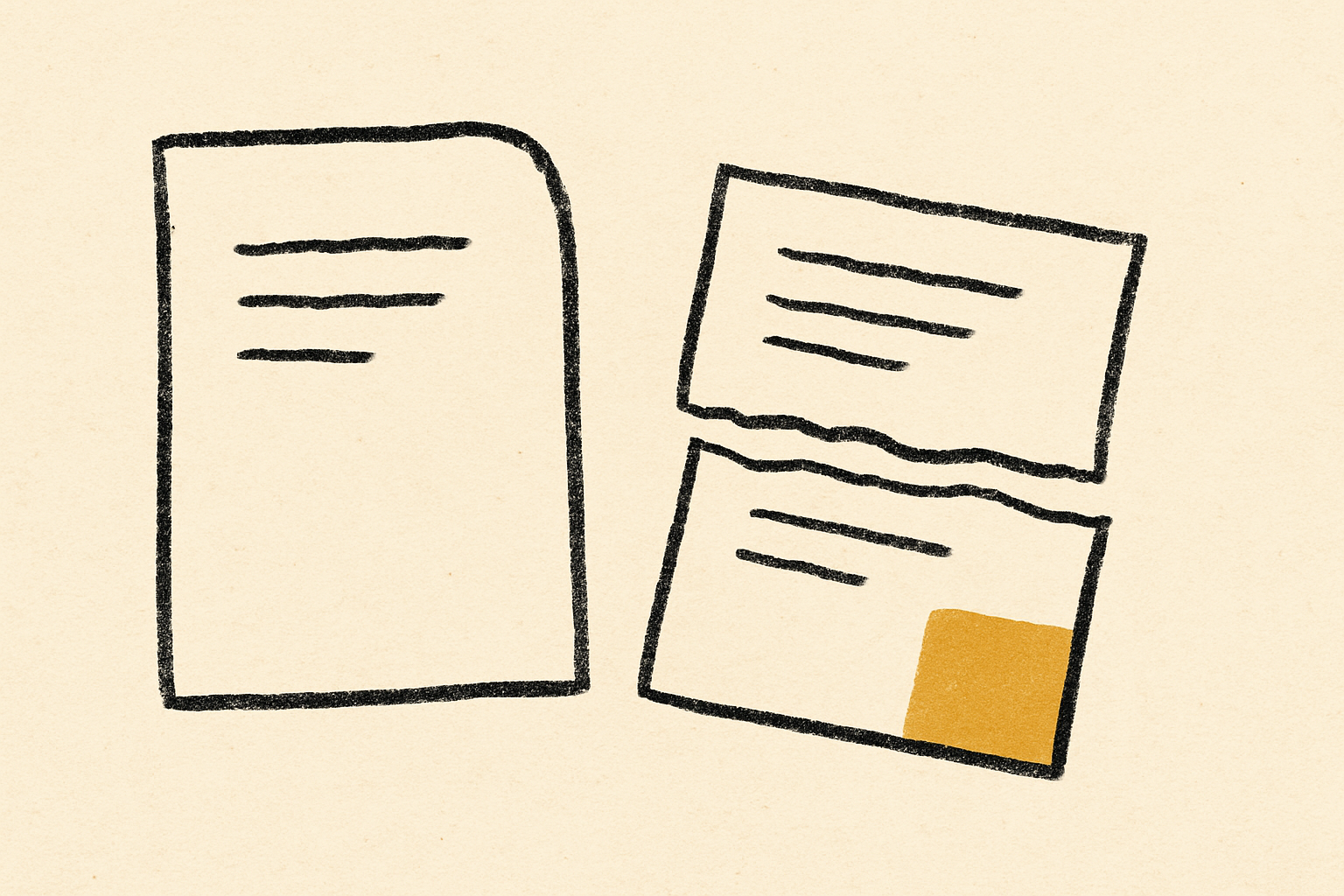
Divorce and breakups grieve in genuinely different shapes, and the honest answer is that one is not categorically harder than the other. Divorce has a specific cluster of difficulties that dating breakups don't — legal entanglement, financial collapse, family pressure, often kids, and an identity that has to be renegotiated from the ground up. Dating breakups have their own difficulties that divorce people sometimes underestimate — no ceremony, no social validation, no permission to be wrecked. This post is the honest comparison, plus a practical look at what helps in each.
The thing both have in common
The neurochemistry doesn't care whether you signed a piece of paper. The dopamine drop, the cortisol spike, the disrupted sleep, the intrusive thoughts about the other person — all of it shows up the same in a six-month relationship and a sixteen-year marriage. Helen Fisher's brain imaging work on romantic rejection found similar activation patterns in the reward and craving regions regardless of the length or formality of the relationship. The body grieves what it bonded to.
This matters because it short-circuits a particular comparison trap. People going through dating breakups sometimes tell themselves their pain doesn't count compared to a friend's divorce. People going through divorce sometimes feel like they should be coping better because dating breakups are "smaller." Both groups are wrong. The pain has its own reasons.
What differs is everything around the pain.
Where divorce is uniquely hard
A few things make divorce a different category of project, not just a longer version of a breakup.
Legal entanglement. A breakup ends when you decide it does. A divorce ends when a court says so. Until the paperwork closes, your ex is still legally tied to you, and you may have to communicate with them on a schedule someone else sets. This means no contact, in the romantic sense, is often impossible. You're negotiating with the person you're trying to grieve.
Financial fallout. Most divorces involve a redistribution of assets that lowers both people's standard of living, at least temporarily. Lawyers cost money. Two households cost more than one. Some people end divorces in worse financial shape than they've been in for a decade. Grief on a budget is grief plus stress, and the stress doesn't go away when the grief does.
Kids, when there are kids. This is the dimension nothing else compares to. You don't get to disappear. You get to co-parent, often for the next eighteen years. Research on the long-term effects of divorce on children shows that ongoing high-conflict contact with an ex-spouse is one of the strongest predictors of poor outcomes for both parents and kids. Your ex remains a primary figure in your life because they're a primary figure in your kid's life. This forces a longer arc of healing because you can never fully close the chapter.
Identity collapse. Most long marriages involve identity entanglement that's qualitatively different from dating. Your friend group is mutual. Your last name might be theirs. Your weekends, your holidays, your retirement plan, your sense of who you are at thirty-eight or fifty-two — all of it is partly defined by the partnership. When that ends, you don't just lose them. You lose a version of yourself.
Family fracture. Divorces don't just split two people. They split families. In-laws, kids' grandparents, mutual friends, the people who came to your wedding. The social rebuild is enormous, and a lot of people don't anticipate the loss of relationships that weren't romantic but were anchored to the marriage.
Time investment grief. Twelve years. Twenty. A specific kind of grief that comes from realizing you can't have that time back, and a specific kind of fear that you don't have enough remaining time to build something equivalent.
Research on divorce and life satisfaction, including longitudinal work by Richard Lucas, has found that while most people return close to their baseline happiness within a few years of divorce, a meaningful minority do not, even seven years out — and the predictors are often financial stability, social support, and whether the divorce was initiated by them or sprung on them. The grief curve is longer than the dating-breakup curve, on average. It's not infinite, but it's longer.
Where dating breakups can be uniquely hard
Now the other side, because it doesn't get written about enough.
No ceremony. Divorce is a documented event. There's paperwork. There are dates. People in your life can mark it. A breakup, especially a non-marriage breakup, doesn't have any of that. You broke up on a Thursday in your apartment and there is no proof anywhere. The lack of ritual makes the loss harder to file.
No social validation. When someone gets divorced, friends show up with casseroles. When someone breaks up after four years of dating but never married, friends say things like "you weren't even married, you'll be fine in a month." The grief is the same and the support is not.
The "you can just leave" gaslight. People assume dating breakups are smaller because exiting was easier. The exit being easier doesn't make the loss smaller. You can lose a person you weren't legally tied to and lose them just as fully.
No structural recovery scaffolding. Divorce has lawyers, mediators, therapists who specialize, support groups, a whole industry around the transition. Dating breakups have your group chat and maybe an app. Sometimes that's enough. Often it's not.
Unrecognized investment. Five years of a serious relationship can involve as much shared life as some marriages — shared lease, shared dog, shared friend group, shared family events. None of it gets recognized by the institutions that recognize divorce.
A side-by-side, honestly
| Dimension | Dating breakup | Divorce |
|---|---|---|
| Initial pain intensity | Comparable | Comparable |
| Length of grief arc | Months to a year typically | Often 1-3 years, longer with kids |
| Legal complexity | None | High, sometimes adversarial |
| Financial impact | Variable, usually moderate | Often significant |
| Social recognition | Often underestimated | Recognized but isolating |
| Identity disruption | Can be high | Almost always high |
| Family fracture | Sometimes | Almost always |
| No-contact feasibility | Usually possible | Often impossible if kids |
| Dating again, sociologically | Faster, less complicated | Slower, more deliberate |
The right read of this table is not "divorce is harder, sorry to dating-breakup people." It's that they're different projects with overlapping pain centers.
What helps, if you're divorcing
A short, honest list:
- Get a therapist who's done divorce work specifically. Not all therapists are good at this. Ask. Divorce-specialized therapists know the pacing.
- Separate the legal grief from the emotional grief. Don't try to make peace with your ex during a contested financial negotiation. Different rooms. Mediation, when both parties can use it, tends to reduce post-divorce conflict compared to adversarial litigation.
- Tell your kids less than you want to. This is hard. They are not your processing partners. They need to know what affects them, not the affair details.
- Keep one ritual that's just yours. A morning walk, a Saturday breakfast, a Sunday call with your sister. Divorce destabilizes everything. One stable thing helps disproportionately.
- Watch the dating-too-fast pattern. A lot of newly-divorced people enter a relationship within six months that ends badly within eighteen. You're processing, not partner-ready. Give it a year.
- Treat the year of firsts as a project. First holidays alone, first birthday, first anniversary that isn't one. Plan them. Don't be heroic.
What helps, if you're going through a "just" a breakup
- Refuse to call it small. Your nervous system can't tell that you weren't married. Treat the grief at the size it actually is.
- Use no-contact aggressively. Unlike divorce, you can. Block, mute, delete. The full toolkit. Our no-contact guide lays out the mechanics.
- Build the missing scaffolding. If divorce has institutions and dating breakups don't, build your own. A weekly check-in with a friend. A standing therapy appointment. A nightly journal practice.
- Use tools that match the situation. Chaz is an iOS no-contact tracker built specifically for the gap dating breakups leave. Streak counter, journal, voice agent. The point is to substitute structure for the institutional support divorce gets and breakups don't.
- Don't compare your pain to a friend's divorce. Comparison grief is its own trap. Your loss is your loss.
- Don't underestimate the timeline. Long dating relationships can take 12 to 18 months to fully integrate. Don't tell yourself you should be over it at three.
Two scenarios
Scenario one: the marriage was loveless for years and the divorce is a relief. People expect a grief crash that doesn't come, and then are blindsided by grief that arrives later, often around the legal finalization. The reason: the relief was real, and the grief was deferred. You grieve the marriage you didn't get to have, not the marriage you actually had. This is normal. It comes in the months after the paperwork closes, when the relief has settled and your nervous system finally has the bandwidth to feel what's underneath.
Scenario two: a five-year unmarried relationship ends and your friends treat it like a tough week. You're devastated and the world is offering you "shake it off" energy. The fix is double. First, tell your three closest people, explicitly: "I know we weren't married but this is a divorce-sized loss to me. I need you to treat it that way." Most good friends rise to that ask. Second, give yourself the ceremony nobody else is giving you. Mark a date. Write a closing letter. Take a trip. Make the ending visible to your own life even if it wasn't visible to anyone else's.
The reframe
The most useful frame is to stop asking which is harder and start asking what each requires. Divorce requires structural rebuild — finances, housing, family, identity, sometimes a career. Breakup requires emotional rebuild without the structural support. Both are real projects. Both take longer than you'll be told. Both end somewhere recognizable as your life again, if you do the work the situation actually requires instead of the work you wish it required.
The person you were before this is gone. Not in a tragic way. In the regular way that big life events change people. The person you are after this is being built right now, one decision at a time. Pick the decisions on purpose. The rest is just time.