On The Mend · App Comparisons
Chaz vs Mend: Which Breakup App Should You Actually Use?


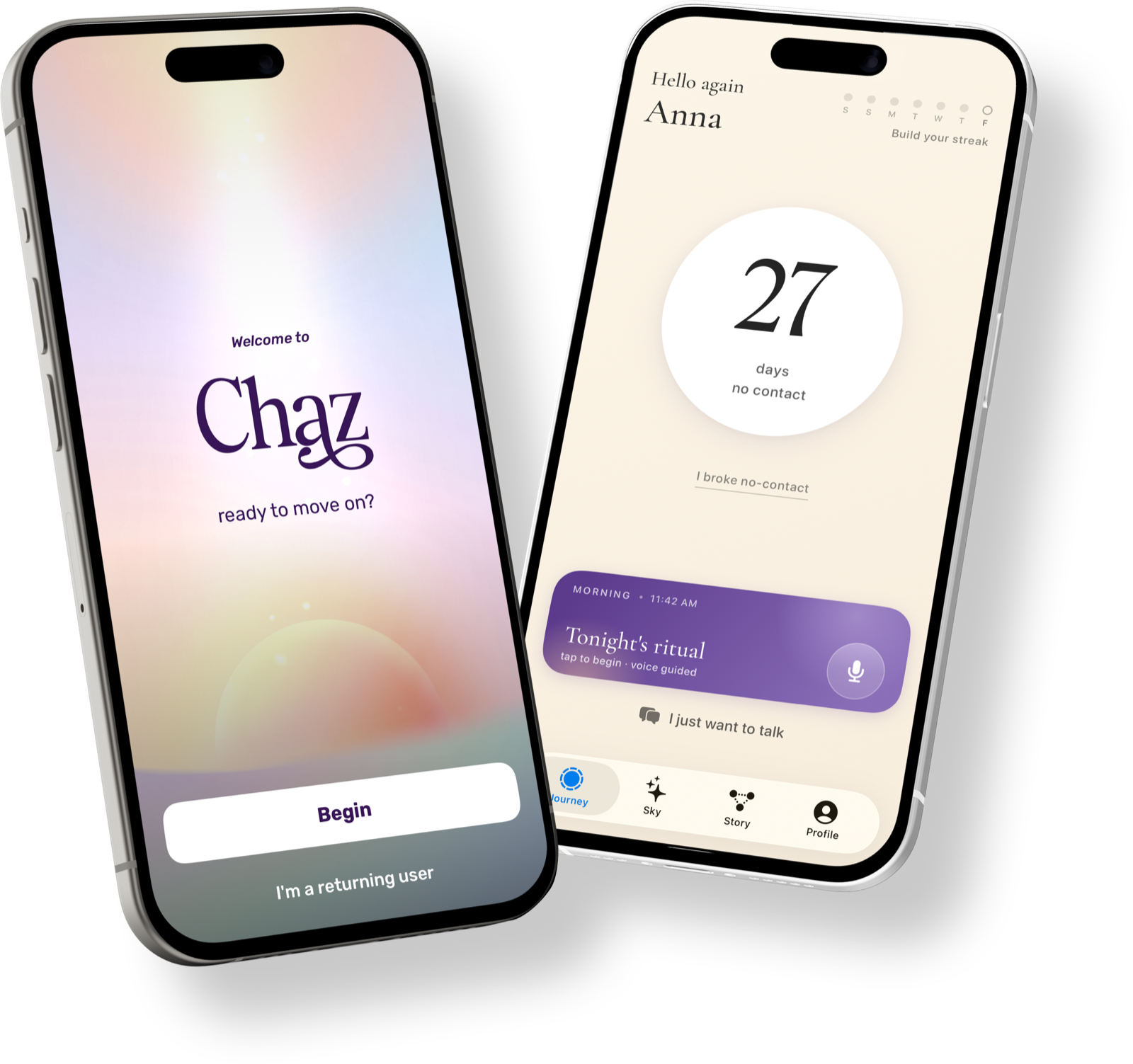
Chaz vs Mend is a real comparison, not a false one — they're both breakup apps, but they solve different problems. Chaz is built around the impulse moment: don't text him, talk to a voice agent. Streak tracker, AI you can yell at, automatic journaling from the voice transcripts. Mend is built around the long arc of recovery: structured audio "trainings," prompted journaling, mood tracking, like a guided course on heartbreak. Pick Chaz if your problem is impulse contact and night-time spiraling. Pick Mend if your problem is more diffuse — you want a calm, structured program to listen through. Many people end up using both, because they don't overlap as much as the marketing suggests.
What each app actually is
I should disclose up front: I built Chaz. I have used Mend. I am going to try to be honest about what each one does well and what each one does not.
Chaz, in one paragraph
Chaz is an AI no-contact tracker for iPhone. The streak counter is the headline feature — it sits on your lock screen so the day count is the first thing you see, before their name in your messages. The differentiator is the voice agent: when the urge to text hits, you open Chaz and you talk to it. Out loud. It talks back. It is sassy, slightly sweary, and on your side. The voice transcripts are quietly turned into a private journal, so you also end up with a written record of what you were feeling on day 11, without having to type at 2 AM. Free. iPhone only. Tagline: don't text him, talk to Chaz.
Mend, in one paragraph
Mend is a breakup-recovery app that has been around for years. The core offering is "trainings" — short audio segments on specific breakup topics, narrated calmly, in the format of a guided course. Daily check-ins ask how you're feeling, build mood charts over time. Prompted journal entries. The tone is calm, gentle, therapeutic-adjacent. Cross-platform (iOS and Android). Free tier exists; full access is a subscription. Verify pricing on the App Store.
Side-by-side
| Chaz | Mend | |
|---|---|---|
| Core feature | Voice agent + no-contact streak | Audio "trainings" + mood tracking |
| Best moment to use | The 2 AM urge | Morning commute, quiet wind-down |
| Tone | Sassy, witty, lightly profane | Calm, therapeutic, gentle |
| Voice conversation | Yes, talk out loud | No |
| Streak tracker | Yes, lock screen widget | Limited |
| Journal | Yes, auto from voice | Yes, prompted text |
| Audio courses | No | Yes, the main feature |
| Mood tracking | Implicit (via transcripts) | Explicit charts |
| Cost | Free | Free trial then subscription |
| Platforms | iPhone | iOS and Android |
| Who it's for | The person about to text | The person processing in general |
The problems they each solve
Heartbreak is not one problem. It is at least four problems happening simultaneously, on different timescales.
- Acute impulse problem: "I am about to do something I'll regret in 90 seconds."
- Daily rumination problem: "I cannot stop thinking about them while I walk to work."
- Identity rebuilding problem: "Who am I without this relationship."
- Sleep and physical problem: "I cannot fall asleep, I cannot eat, my chest hurts."
Chaz is built for problem 1, and partially for problems 2 and 3.
Mend is built for problems 2 and 3, with some support for problem 4.
Neither will solve problem 4 by itself. Neither will get you through a breakup without some other support (friends, therapy, time).
When Chaz wins
Chaz is the better fit if:
- The thing you're losing to is the urge to contact your ex. Specifically.
- The bad moments are at night, when you can't see, you don't want to type, you just want to say the thing out loud.
- You like a friend who roasts you over a coach who validates you.
- You want one app that does no-contact streak + journal + the venting moment.
- You want it free.
- You're on an iPhone.
There's a scenario I had in mind when building Chaz. It is 11:48 PM. You are in bed in the dark. You're not going to open an app, scroll to a journal prompt, type a paragraph, save, close. You're going to text him. Or you're going to talk to something hands-free.
The voice piece is the whole point. Mend has good content; you have to be sitting up and paying attention for it. Chaz is what you reach for when you can't sit up.
When Mend wins
Mend is the better fit if:
- You want a guided course experience, like a podcast that is specifically about your breakup.
- You are past the acute impulse phase and into the long processing phase.
- You're on Android and Chaz literally can't help you.
- The audio production quality matters to you (Mend has invested in this; it sounds professional).
- You want a structured mood chart you can look at over weeks to see if you're getting better.
- A calm, therapeutic tone feels right for you, and a sassy roast tone feels wrong.
If you're the person who downloads Calm or Headspace and actually uses them, you'll get along with Mend. It's in that family.
Where they overlap (and don't)
Both apps have journaling. The difference is execution.
- Chaz's journal writes itself from your voice. You don't have to type. You don't have to think about a prompt. You just talk, and entries appear. It's good for people who hate journaling but want a record.
- Mend's journal is prompted, text-based, intentional. You read the prompt, you type the answer. It's good for people who like journaling and want structure.
Both apps mention no-contact, but only one is built around it. Mend acknowledges no-contact as part of recovery and has content about it. Chaz puts the day count on your lock screen and centers the entire app around the streak. If protecting no-contact is your main goal, this difference matters.
Neither app replaces therapy. Both are explicit about that, more or less. If your breakup is causing symptoms that are interfering with work, sleep for weeks, or your ability to function, you need a person, not an app. There's a real difference between breakup depression and clinical depression.
A scenario for each app
Mend morning, 7:30 AM. You're on the train. You have earbuds in. You open Mend, pick today's training — "Why you still feel attached to someone who treated you badly." Twelve minutes. You listen. You feel slightly more sane by the time you reach your stop. You mark your mood for the day. You close the app and you go to your meeting.
Chaz night, 2:14 AM. You've been awake for two hours. Your phone is two inches from your hand. You open Chaz. You hit the talk button. You say, "I miss him so much I feel like I'm going to throw up." The voice agent says something back that is half-validating, half-roasting. You talk for four minutes. You laugh once. You cry a little. Your streak ticks over to day 12 because it's already past midnight. You close the app. You fall asleep.
Both of those moments are real. Most people have both of them. That's why the two apps can coexist in the same recovery.
Pick Chaz if…
- You almost-text or actually-text your ex more than once a week
- Your worst moments are at night
- You want one app, free
- You'd rather laugh than meditate
- You're on iPhone
Pick Mend if…
- Your urge to contact is mostly under control, but the rumination is wrecking you
- You want a structured curriculum
- You prefer a calm therapeutic tone
- You're on Android
- You're past the first month and into the slower phase of healing
Pick both if…
- You can afford the Mend subscription
- You like having two tools for different moments
- You want voice + audio + streak + journal all available
What the research says about both approaches
Worth noting that the underlying tools both apps use have a real evidence base.
The audio-content model (Mend) draws from cognitive behavioral therapy and psychoeducation — teaching the user about what's happening to them and giving them frameworks. Meta-analyses of CBT for depression consistently show effects, and psychoeducation is a core part of those interventions.
The expressive writing and verbal venting model (Chaz) draws from James Pennebaker's decades of expressive-writing research at UT Austin, which has shown that writing or speaking about emotional experiences reduces intrusive thoughts and improves recovery markers. Talking it out is the verbal cousin of journaling it out, and shares the mechanism.
The streak / behavioral activation model (also Chaz, partly Mend) draws from behavior change research (Fogg, Wood) showing that environment design and small wins outperform willpower.
In other words: both apps are pointing at real research. They are just selecting different tools from the same toolbox.
The honest verdict
If I had to put one app on the phone of a friend going through a breakup today, sight unseen, I would put Chaz on it. Because the most common point of failure in a recovery is the impulse moment, and Chaz is built for the impulse moment.
But I have friends for whom Mend would be the better first install. Friends who don't have impulse problems, who aren't reaching for the phone, who are just sad and need structure and want a guided voice in their ear. For them, Mend is more useful than Chaz, and I'll say so.
The wrong question is "which is the best breakup app." The right question is "which problem am I losing to right now." Answer that, then pick.
If you can't figure out which problem you're losing to, install Chaz (it's free) and try it for a week. If the issue isn't impulse contact, you'll know within seven days, and you can pivot to Mend or to something else. The breakup is going to keep happening either way.