On The Mend · Tactical
How to Do No Contact When You Still Live Together


When you still live together, no contact has to be restructured into something more like cohabitation no contact: shared zones with rules, schedules that don't overlap, written logistics for chores and bills, and zero personal interaction. You can't actually disappear. What you can do is reduce contact to the level you'd have with a roommate you barely know. Here's the playbook for the in-between weeks before one of you can move out.
The realistic goal
You are not going to be invisible in your own home. The goal is not zero interaction; the goal is zero emotional interaction.
That means:
- You will pass each other in the hallway. That's fine. A nod is fine. Conversation is not.
- You will share a fridge. That's fine. You will not share meals.
- You will see them in the morning. That's fine. You will not have coffee together.
Think of it as living with a stranger you happen to know everything about. Awkward, structured, temporary, survivable.
Step 1: Have the conversation. Once.
Before any of this works, you both need to agree on the framework. Have one conversation, in a calm moment, that establishes:
- The breakup is final. (If it's not, this isn't the post for you.)
- One of you is moving out by a specific date.
- Until then, the rules below apply.
- Communication will be logistical only and primarily written.
Set a 20-minute timer for this conversation. When the timer goes off, the conversation is done. You can come back to it once if needed. After that, it's text only.
Then write the agreement down in a shared doc or note. Both of you having read the same words removes the "I didn't know that's what we said" argument.
Step 2: Establish zones
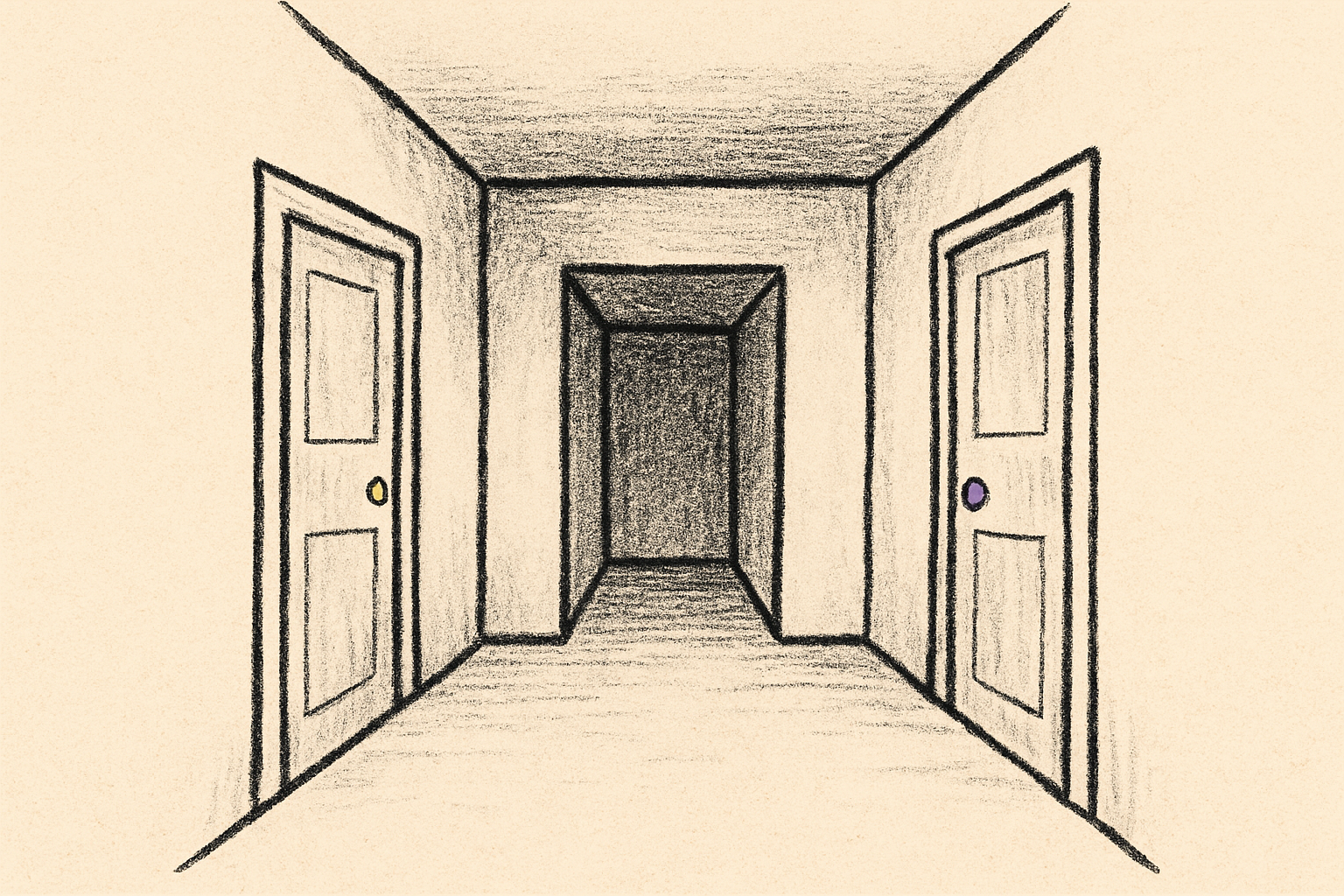
The apartment now has zones. You each get primary territory.
- Their zone. Their bedroom (if you have separate bedrooms now) plus a primary common area, say the living room.
- Your zone. Your bedroom plus a different primary, say the office or the dining area.
- Shared zones. Kitchen, bathroom, laundry. Use by schedule, not by overlap.
If you have one bedroom and one couch, one of you is on the couch. The person whose name is on the lease usually gets the bedroom, but this is negotiable. The person sleeping on the couch has the right to the living room as their default zone in the evening, so don't displace them there.
Write the zone map down. Yes, on paper. Stick it on the fridge if you have to. The point is that you don't have to renegotiate every Tuesday at 8pm where you're allowed to sit.
Step 3: Offset your schedules
If you used to wake up at the same time, one of you shifts.
- One person showers 6:30–7:00am. The other 7:15–7:45am.
- One person uses the kitchen 6:00–7:00am. The other 7:30–8:30am.
- One person eats dinner 6:00pm. The other 7:30pm.
- One person uses the living room 7–9pm. The other 9–11pm.
You don't have to perfectly avoid each other. You just have to stop the predictable collisions: the morning coffee kitchen, the post-work decompression on the couch, the late-night fridge raid. Those are the friction points where conversations start that you don't want to have.
Step 4: Logistics in writing, not in conversation
Anything that needs to be coordinated, you write down. You do not say it.
The two-channel system:
- Shared note (Apple Notes, Google Doc, whatever). For ongoing logistics. Rent, utilities, who's doing what chore this week, when the cleaner comes.
- Texts for time-sensitive things only. "Plumber arriving at 2pm." "I'll be home late, don't worry about the door."
That's it. No "how was your day" in either channel. No emoji. No tone. Just dates, times, dollar amounts, tasks.
If you live with them and were used to talking about your day every evening, this part feels brutal at first. It is supposed to. The contact you were having was the contact that kept you bonded. You're trying to debond.

Step 5: Divide the chores like a roommate situation
Pretend you just moved in with a Craigslist roommate. How would you divide chores? Probably:
- A rough split of duties on paper.
- Each person handles their own dishes immediately.
- No sharing groceries. Separate shelves in the fridge.
- One person takes out trash on Mondays, the other on Thursdays.
- Cleaning rotation written down, no asking.
The reason this matters is that "we used to share groceries" is a contact vector. "Hey did you eat my yogurt" is a fight waiting to happen at 10pm on a Tuesday. Eliminate the shared resource, eliminate the fight.
Step 6: Sleep separately
If you have two bedrooms, this is easy. If you have one, one of you takes the couch or an air mattress, and you stick with it.
Do not sleep in the same bed. Not "just tonight because we're both tired." Not "but it's our last week." Bed-sharing is the most intimate contact two people have. Continuing it is just delaying the breakup. Physical closeness at night is itself a bonding input — your nervous system reads it as the relationship still being live, no matter what either of you said in the kitchen earlier. You're allowed to grieve. You're not allowed to relapse into the cuddle because it's available.
A vivid scenario
It's 10:45pm. You're brushing your teeth in the shared bathroom. They walk in to brush theirs too. The mirror is small. Your elbows could touch.
What you used to do: small talk, probably about the day, probably ending with one of you crying.
What you do now:
- Finish what you're doing.
- "All yours." Walk out.
- Close the door behind you.
- Go to your zone for the rest of the night.
If they try to start a conversation, the response is "I'm heading to bed, can we keep it to logistics?" Then leave.
This will feel cruel for about a week. It is not cruel. It is what cohabitation no contact looks like.
Step 7: Friends, dating, and visitors
The hard rules while you cohabit:
- No new dating happens in the shared apartment. Not them, not you. Date elsewhere. Stay elsewhere.
- Mutual friends visit one of you at a time, by arrangement. Not both, not by accident.
- Family visits go on the calendar. With the other person's notice.
- No dramatic exits. "I'm going to so-and-so's, don't ask" is not the move. "Out tonight, back tomorrow" is the move.
The point is to remove ambiguity. Cohabiting through a breakup is a thousand small ambiguities, and each one is an opportunity for a fight or a relapse.
Step 8: The exit plan, on the calendar
The single most important thing about cohabitation no contact is that it ends.
Pick the date one of you moves out. Put it on a real calendar. Tell each other. Write it in the shared note. Reference it whenever the tension peaks: "We have 19 days. We can do 19 days."
If the date is more than 60 days out, push hard to make it sooner. Couches, sublets, parents' houses, friends — temporary housing is usually findable if you're willing to be uncomfortable for two months. The longer cohabitation drags, the more likely the rules erode.
Things to plan in parallel:
- Who keeps the lease, the furniture, the dog, the plates.
- How the security deposit gets split.
- Whether and how you'll see each other after move-out (most healthy answer: no, for at least 90 days).
- Address forwarding, shared accounts, joint subscriptions, shared bank account if any.
A breakup mediator (yes, that's a profession — usually a family therapist or a divorce coach) is sometimes worth one or two sessions just to handle the asset split without it becoming a fight. The same logic underlies Bill Eddy's BIFF framework — outsource the emotional regulation to a structured format so two stressed people can still finish a logistics conversation.
Step 9: Take care of you, when they're in the next room
You still need to do your no contact emotional work, and the hardest part is that the person you're going no contact with is 30 feet away in the next room.
- Headphones. Always. The audio bubble is your private space.
- A nightly walk outside before bed. Time outdoors has measurable effects on mood and stress — and you get out of the apartment without making it a thing.
- Journal in your zone, in writing or on your phone, not out loud.
- Voice memos to friends, not phone calls in the apartment.
- A nightly walk that gets you out for 45 minutes alone.
- For the emotional venting that you can't do in shared space, an AI you can yell at quietly with headphones in works. The Chaz app does exactly this — talk through what's spinning in your head without anyone in the apartment hearing it.
Step 10: The day they move out
The move-out day is its own event.
- Pick a day you can be out of the apartment from morning to evening. Let them pack and load in peace.
- Don't watch. Don't help with the things they're taking. Don't stand in the doorway looking sad. Be elsewhere.
- Return after they've left. Walk through the empty space slowly. It's allowed to hurt.
- Don't text them goodnight. Even if it feels symbolic. Especially because it feels symbolic.
The first night alone in the apartment is harder than you expect. Plan it. Have a friend over. Order dinner. Watch something dumb. Sleep with the lights on if you have to.
What this earns you
Cohabitation no contact is not a transitional convenience. It is the work of separating two lives that were intertwined into the wall outlets of the same apartment. Doing it cleanly — the zones, the schedules, the writing-not-talking, the firm exit date — earns you a cleaner shot at the actual no-contact phase once they leave.
The version of you on day 91, alone in your own space, will be enormously grateful to the version of you on day 12 who did not have one more "just one talk" at 11pm in the kitchen.
19 days. 33 days. 47 days. Count down. Hold the line.